Historisches Rathaus, Renaissance town hall in Deidesheim, Germany
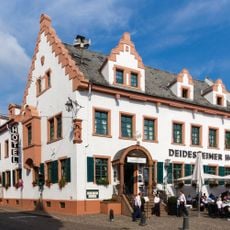
The Historisches Rathaus is a Renaissance building featuring a distinctive double outdoor staircase sheltered by a canopy supported by Tuscan columns. The facade displays elaborate decorative elements and today serves as the administrative center and home to the Wine Culture Museum.
A predecessor building stood on the site by 1459; the present structure dates to around 1532, when the year and the arms of Speyer bishop Philipp von Flersheim were placed on the north gable. The lower storey was once a Romanesque hall used for markets and courts. Severely damaged in 1689 during the War of the Palatine Succession, it was rebuilt, with the second storey and present roof added in 1709.
The council chamber was refurnished in 1912 in a modern Renaissance style after Franz Eberhard Buhl donated twelve carved chairs and three tables from his uncle Eugen Buhl's estate. Munich architect Hugo M. Roeckl directed the work. Stained-glass windows donated by Buhl and the Bassermann-Jordan brothers show coats of arms of noble families such as Schliederer von Lachen and Sturmfeder von Oppenweiler, plus benefactors including Andreas Jordan.
The building serves as the local government center and houses the Wine Culture Museum, accessible during regular visiting hours. Check opening times in advance as they may vary seasonally or due to local events and administrative activities.
The Historisches Rathaus forms the backdrop for the Geißbockversteigerung, the goat auction held each Pentecost Tuesday. The event recalls the legend that a goat once settled a dispute between Deidesheim and Lambrecht over grazing rights in the forest.
The community of curious travelers
AroundUs brings together thousands of curated places, local tips, and hidden gems, enriched daily by 94,532 contributors worldwide.