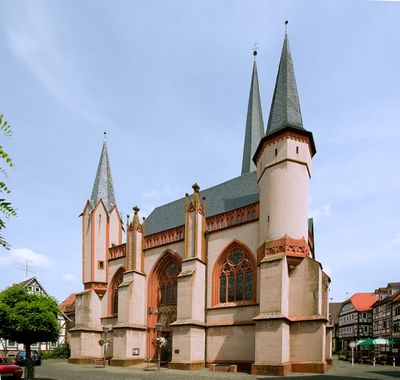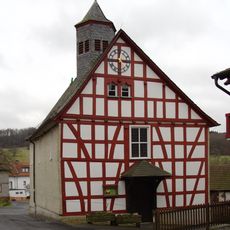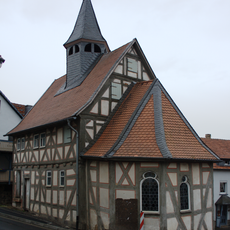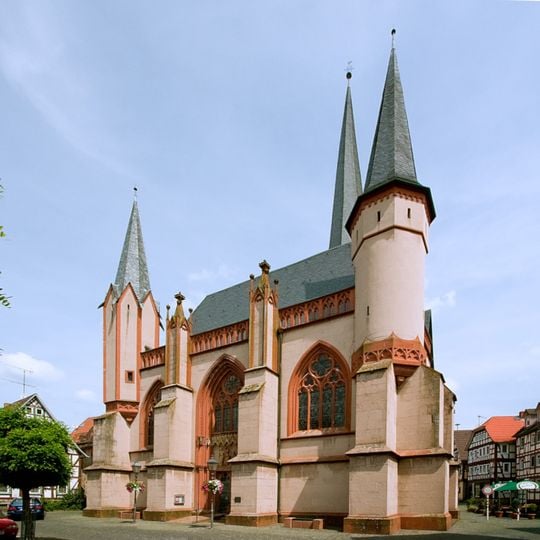
Liebfrauenkirche zu Schotten, Gothic church in Schotten, Germany.
Liebfrauenkirche zu Schotten is a Gothic hall church with three naves, four bays, and an eastern section defined by a tall crossing tower. The interior space is structured by this architecture, creating a vertical effect that draws the eye upward.
The Liebfrauenkirche was built from 1330 to 1385, funded by Lukarde von Eppstein and Konrad von Trimberg. A letter of indulgence issued in Avignon on 13 February 1330 by Archbishop Petrus of Nazareth and twelve named bishops under Pope John XXII made it a pilgrimage church that same year. In 2015 a three-year restoration was approved because of the leaning tower and the poor timber structure, supported by the Deutsche Stiftung Denkmalschutz.
The winged high altar, made around 1373–1380 by the anonymous Schotten Master, has eight painted pairs of scenes on its inner side depicting the lives of Mary and Jesus, and four pairs on the outer side covering the Passion and Resurrection. The twelve pairs may refer to the twelve tribes of Israel or the twelve apostles. The scenes flow into one another without dividing strips, unlike most altars of the period.
The organ, built in 1782–1783 by the Philipp Ernst Wegmann workshop, was moved to the west gallery in 1972 and keeps its original case with two angel figures holding trumpets. It has 31 stops on two manuals, six of them original. The church was closed for a three-year restoration from 2015 because of the leaning tower and the poor timber structure.
The colors of the altar paintings have preserved their intensity over centuries because mineral pigments such as lapis lazuli, azurite, malachite, and cinnabar were used in their creation. These special materials made the works exceptionally durable, allowing visitors today to experience the original luminosity.
The community of curious travelers
AroundUs brings together thousands of curated places, local tips, and hidden gems, enriched daily by 93,920 contributors worldwide.