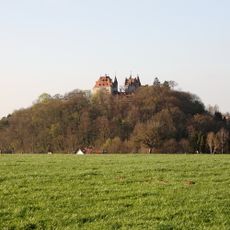
Holsterburg, Medieval castle ruins in Warburg, Germany
Holsterburg is a buried lowland castle site southeast of Warburg, its remains covered by an earth mound. Excavations from 2010 to 2017 revealed an octagonal ring wall about 87 metres long, 1.70 metres thick, enclosing 428 square metres with a diameter of 26 metres. The wall consists of carefully cut limestone blocks, some with fishbone patterns, and incorporates a limestone channel likely used for heating.
The Berkule brothers built the castle before 1191 near the village of Holthusen to control the Warburg–Kassel road and its farms. In 1245 the Holthuseners attacked Warburg with arrows, and on 6 November 1294 troops from Warburg, Marsberg, Höxter, Fritzlar, Hofgeismar, Wolfhagen and Naumburg stormed and destroyed the castle. Johann Berkule submitted to the Bishop of Paderborn and became one of his castle men in Warburg.
The name Holsterburg derives from the vanished village of Holthusen, first recorded in 1170. The castle was probably built around 1150 by the brothers Hermann and Bernhard Berkule, who used it to control the farms and the road from Warburg to Kassel. After its destruction in 1294 the site was covered by an earth mound, possibly to erase the memory of the Berkule family.
The site is accessible via marked hiking trails from Warburg and is explained through informational panels. Visitors should wear sturdy footwear since the ground is uneven and paths can become slippery when wet.
Among the finds was a one-piece ivory double comb with carved motifs, dated to the third quarter of the 12th century and interpreted as a liturgical comb. It shows the castle's occupants owned objects of high craftsmanship, not only everyday tools.
The community of curious travelers
AroundUs brings together thousands of curated places, local tips, and hidden gems, enriched daily by 93,246 contributors worldwide.