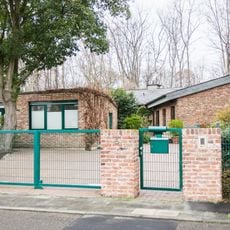
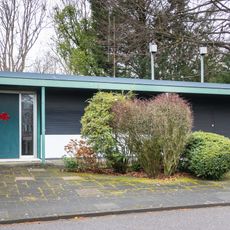
Römergrab Köln-Weiden, Roman burial chamber and archaeological museum in Weiden, Germany.
The Römergrab Köln-Weiden is an underground burial chamber (hypogaeum) from the 2nd century, measuring 3.60 by 4.40 metres and 4.06 metres high under its barrel vault. Its walls are built of large unmortared blocks of Brohltal tuff, while the door frame is red sandstone. Three deep niches with marble-clad couches and 29 smaller ash niches line the walls.
The burial chamber dates to the second century and was discovered by chance in 1843 when a carter found the stone seal during construction work. This discovery allowed archaeologists to learn more about Roman settlement in the region.
The chamber's furnishings recreate a Roman dining room: stone cathedra chairs stood before the side niches, facing marble-clad couches in the main niches. A Carrara marble sarcophagus with reliefs, perhaps of the seasons, is the main exhibit; its lid, made for a larger coffin, was cut down and bears a blank tabula.
The chamber lies on Aachener Straße 1328 in the Weiden district, roughly nine kilometres west of Cologne's centre along the old Via Belgica. Visitors descend about six metres below ground level into a single room of 3.60 by 4.40 metres, so the space is tight and the stairway steep. The site is reached by car or bus on the Aachener Straße; check opening days with the Römisch-Germanisches Museum before setting out.
The chamber held 29 small niches for ash urns and offerings, plus three main niches with marble-clad couches. Two limestone basket chairs stood before the side niches, recreating a dining room (triclinium) where the deceased were honoured at meals. Stone furniture of this kind is otherwise unknown in the northern provinces.
The community of curious travelers
AroundUs brings together thousands of curated places, local tips, and hidden gems, enriched daily by 94,039 contributors worldwide.