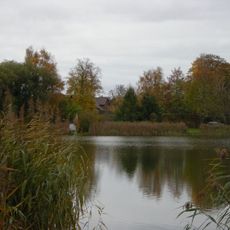
Manor house in Bülow, Manor house in Bülow, Mecklenburg-Vorpommern, Germany.
The Manor house in Bülow is a two-storey Baroque building erected from 1742 to 1746 for the Prussian officer Magnus Friedrich III. von Barner on older remains. In 1842 Heinrich Franz von Barner raised it by a half-storey in Italian Neo-Renaissance style and added four corner towers. The gable triangle of the original central risalit holds the alliance coat of arms of the von Barner and von Maltzahn families; stables of the estate survive alongside.
Bülow was first documented in 1262; since 1573 the estate has belonged to the von Barner family through purchase and exchange. The Prussian officer Magnus Friedrich III. von Barner had a two-storey Baroque manor built on older remains between 1742 and 1746. In 1842 Heinrich Franz von Barner raised the building by a half-storey in the style of the Italian Neo-Renaissance and added four corner towers.
The manor served as the center of agricultural life and shaped the village community for generations through its role as a working estate. The buildings and courtyards still show how closely daily life in the village was connected to the rhythm of the farming operation.
The manor stands in the village of Bülow in the Ludwigslust-Parchim district, with a small pond directly in front of the house. Several listed stables from the former estate survive alongside it. The building was long vacant and is now being restored by a new owner, so the interior is not open to visitors; the house and pond are seen from the village street.
The estate is part of one of Europe's greatest concentrations of manor houses, an architectural distinction of this region. This abundance of surviving noble residences makes Mecklenburg an uncommon window into the historical farming structure of northern Europe.
The community of curious travelers
AroundUs brings together thousands of curated places, local tips, and hidden gems, enriched daily by 94,368 contributors worldwide.