Homberg Castle, Medieval castle ruins in Homberg (Efze), Germany.
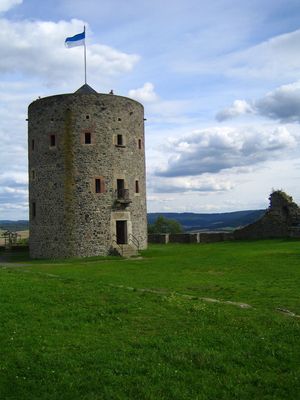
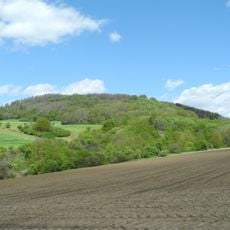
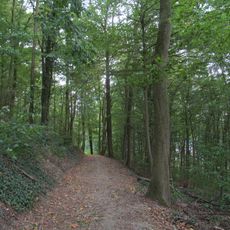
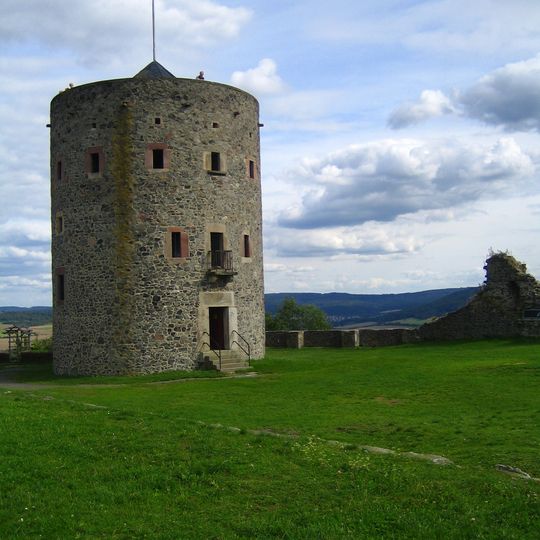
The Hohenburg, also called Homberg, is a ruined hilltop castle on the wooded Schloßberg, a basalt cone rising above the Efze valley in Homberg (Efze). Its core consisted of a ring wall 1.5 metres thick, a round bergfried, a palas with knights' hall, a well house over a 150-metre well, stables, a gun house and an arsenal. The squat tower with an 11-metre diameter and 14-metre height was built from 1952 to 1958 as a lookout on old foundations.
The castle's builders are unknown; it is first documented in 1246, after a "Rentwich von Hohenburg" was mentioned in 1162. From around 1190 it belonged to the Landgraviate of Thuringia, and in the 13th century it passed to the Landgraviate of Hesse under Henry I. In 1508 Archbishop Hermann IV of Cologne, brother of Landgrave Ludwig II, had it extensively rebuilt. It was not rebuilt after the Thirty Years' War and served as a quarry for the town.
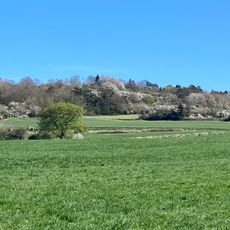
The ruin sits directly above the old town and can be seen from many streets below, making it a constant presence in daily life. People come here to walk, sit, and look out over the hills that surround the town.
The ruin is easy to reach on foot from the town center by following marked paths up the hill. Sturdy shoes are a good idea, as the ground is uneven and some sections of the path are not paved.
Within the grounds stands one of the deepest castle wells in Germany, dropping about 150 meters (492 feet) into the rock and lined with careful brickwork all the way down. A well of this depth was extremely rare for a medieval fortress and points to how seriously the garrison prepared for a possible siege.
The community of curious travelers
AroundUs brings together thousands of curated places, local tips, and hidden gems, enriched daily by 93,972 contributors worldwide.