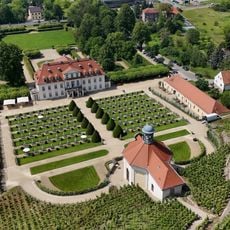
Hohenhaus, Cultural heritage monument in Radebeul, Germany
Hohenhaus is a former vineyard estate whose manor house, a two-storey Renaissance core, stands on a south-facing slope above cellars, so the garden side shows three levels. It has a tall hipped roof with dormer gables, a three-bay glazed veranda reached by a double outdoor stair, and a round stair tower with a hood on the west side. The 12-hectare park rises about 80 metres up the Barkenberge.
The slope was recorded as a vineyard in the 14th century and in 1373 belonged to Bishop Konrad II of Meissen, with a wine press already on the estate. In the 15th century the Meissen bishops built their summer residence on the Bischofsberg here. In 1584 the Naundorf farmer Simon Clauß acquired the hill and the press later named after him, the Bischofspresse.
The estate was called Bischoffsberg until around 1830, when it took the name Hohenhaus. Gerhart Hauptmann, who often stayed in the 1880s at what he called the "nest of birds of paradise", married a daughter of the owner Thienemann, as did his brothers Carl and Georg; his early works Liebesfrühling and Der Hochzeitszug were premiered here.
The property is laid out on steep slopes, so sturdy footwear and reasonable fitness are necessary when exploring. Spring and autumn are the best times to visit when the terrain is most accessible for walking.
The park holds a rare Osage orange (Maclura pomifera) on the sheltered east side of the manor house, a North American species. In autumn it bears large, round, yellow-green fruits with a wrinkled surface. A Japanese pagoda tree stands directly before the south front and flowers only in August.
The community of curious travelers
AroundUs brings together thousands of curated places, local tips, and hidden gems, enriched daily by 94,392 contributors worldwide.