Leibis-Lichte Dam, Embankment dam in Thuringia, Germany.
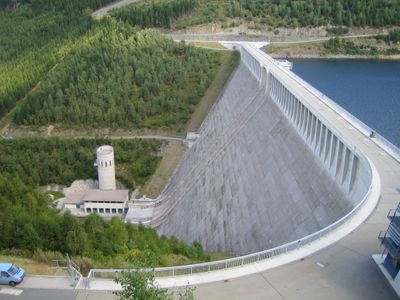
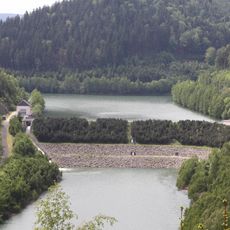
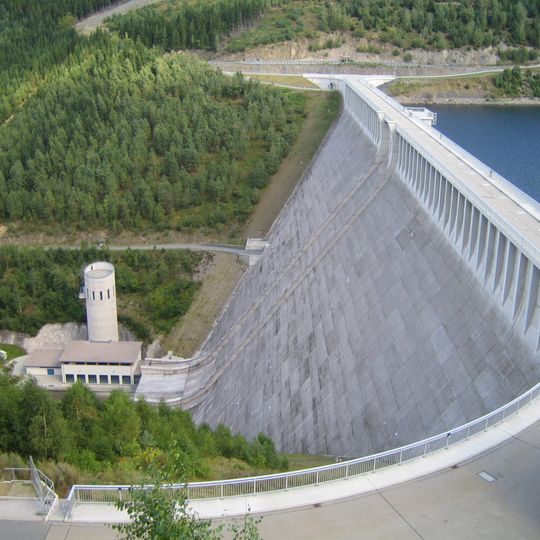
The Leibis-Lichte Dam is a 102.5-metre-tall concrete gravity dam on the Lichte River in the Thuringian Highland. Its wall is built from about 1,090 concrete blocks in five mixes, with heights mostly 2.50 m and widths of 10 m. The reservoir is preceded by the Deesbach Forebay.
Planning began around 1965, but construction of the dam started only in September 2000 after decades of dispute; the foundation stone was laid on 6 September 2002. Impounding began in February 2005, the structure was completed that September, and the official inauguration took place on 12 May 2006, with filling finished by mid-2008. The concrete gravity dam cost about 140 million euros.
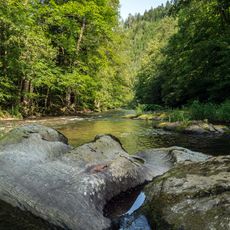
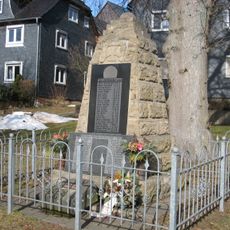
The dam's name comes from the village of Leibis, whose 100 residents were resettled to Neu-Leibis, and from the impounded Lichte river. Its construction was controversial, and 33 ecological compensation measures accompanied it, including the renaturation of watercourses, reshaping of 270 ha of forest and the release of 40 capercaillies in the Lichtetal.
The dam stands between the Geiersthal section of Lichte and Unterweissbach in the Thuringian Highland; the Deesbach Forebay sits upstream of the main reservoir. The structure is reached on foot, and the crest is not open to visitors. The Lichte and Sorbitz valleys below carry the water onward through tunnels toward the Zeigerheim treatment plant.
The dam's water arrives through three tunnels bored with a 38-metre machine. The Katzestollen feeds the reservoir by gravity from the Katzetal near Katzhütte, while Lichtestollen I and II carry raw water onward to the Zeigerheim treatment plant, crossing the Sorbitz valley in two 220-metre pipe culverts.
The community of curious travelers
AroundUs brings together thousands of curated places, local tips, and hidden gems, enriched daily by 95,408 contributors worldwide.