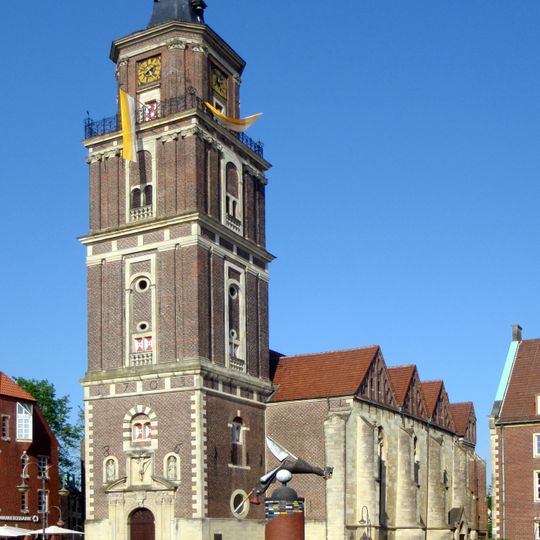
St. Lamberti, Coesfeld, Gothic parish church in Coesfeld, Germany
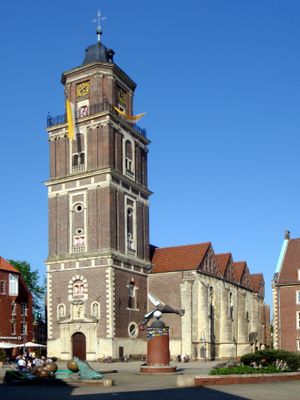
St. Lamberti is a Gothic parish church in the heart of Coesfeld with pointed arches and ribbed vaults typical of the style. Large windows fill the interior with natural light, highlighting the vertical lines and architectural details throughout the space.
The oldest surviving parts are 13th-century nave piers of a hall church, preceded by two stone buildings and a twin-tower facade. In 1473 the local master Henric de Suer built the two-bay choir with side apses and renewed the aisles and nave vaults. The south tower collapsed in a November storm in 1635 and the north tower in 1681; the bells survived. Gottfried Laurenz Pictorius built the new tower from 1686 to 1703.
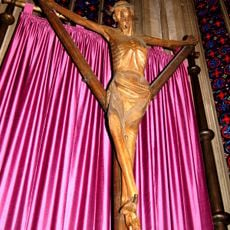
The church's name comes from Saint Lambert, and its most venerated object is the Coesfelder Kreuz, a forked crucifix from the early 14th century that holds a relic of the True Cross in its corpus. Considered wonder-working, it drew pilgrims for centuries and is still honoured by many believers. The tower hall keeps a painted wooden ceiling said to reuse boards from the earlier Romanesque flat roof.
The church sits in the central old town and is easy to reach on foot from the main squares and streets. Visitors should check opening times in advance since regular services may limit access at certain times of day.
The two towers collapsed in November storms, the south one in 1635 and the north one in 1681. Their wooden bell frame survived inside the ruin, so the bells were recovered the following spring and now form the oldest complete ring of bells in Westphalia. The present 93-metre tower by Gottfried Laurenz Pictorius was built from 1686 to 1703.
The community of curious travelers
AroundUs brings together thousands of curated places, local tips, and hidden gems, enriched daily by 93,841 contributors worldwide.