Löwengrube bei Altdorf, Historical quarry and cave system in Altdorf bei Nürnberg, Germany
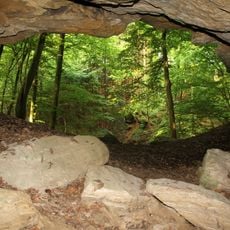
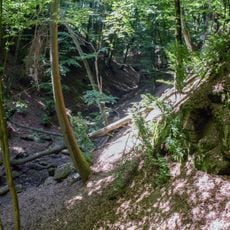
Löwengrube bei Altdorf is an artificial rock cellar and rock gallery carved into Rhät sandstone south of Altdorf. The main chamber is spacious, and a long gallery with side arch openings, once used as a bowling alley, remains visible. The surrounding site was formerly a quarry, and a small Rhät ravine leads into the rock.
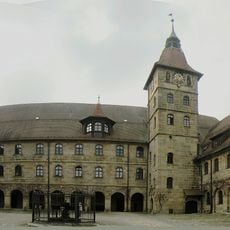
The quarry supplied fine-grained sandstone for Altdorf's university building (now the Wichernhaus) from 1571 to 1575, and its stone was also used for the town wall in the 14th and 15th centuries. Ox carts hauled the blocks to the old town via the Grasiger Weg. The site was rediscovered on 11 March 1686 by Hofmeister Johann Christian Christ and Baron Friedrich Gottlieb von Löwenstern, who cleared the wilderness and had seats and a trumpeters' stand carved into the rock.
After its rediscovery in 1686, the site became a gathering place where students organized celebrations and social events. This tradition shaped student life in the town until the university closed in 1809.
A flashlight is essential for exploring the rock cellar, as the underground passages receive little natural light. Access is via a hiking trail marked with a white number 3 on a green background.
The Bavarian State Office for the Environment, not a national geological survey, lists the Löwengrube as geotope 574G001. The designation covers the former quarry and the small Rhät gorge where light-coloured Rhaetian sandstone outcrops at the upper slopes and along the stream that soon flows into the Schwarzach.
The community of curious travelers
AroundUs brings together thousands of curated places, local tips, and hidden gems, enriched daily by 94,476 contributors worldwide.