Wolfschlucht, Canyon near Zwingenberg, Germany
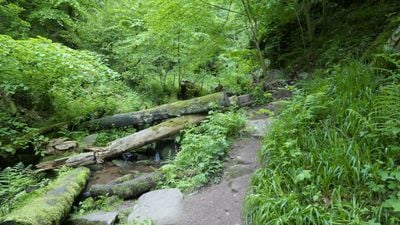
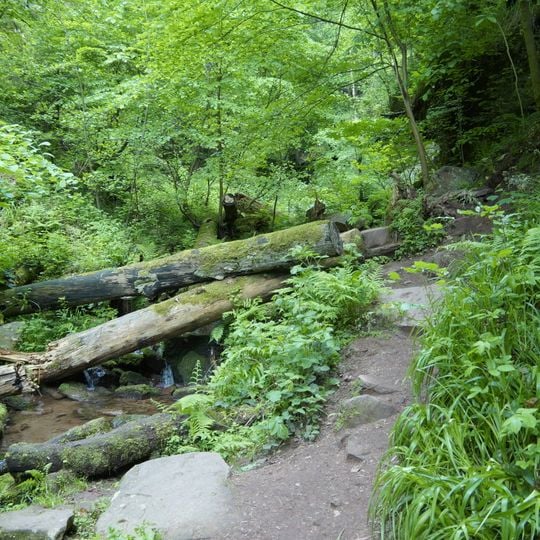
Wolfschlucht is a roughly one-kilometre-long V-shaped gorge cut by the Schlossbächlein stream into the red sandstone of the Odenwald. Its narrow floor is sometimes bordered by rock walls and overhangs, with moss-covered fallen trunks leaning against the cliffs, moistened by constant spray. The stream drops over several-metre-high rock ledges, and the path partly runs above the valley floor on the left slope.
The Wolfschlucht is a one-kilometre-long V-shaped valley cut by the Schlossbächlein stream into the Buntsandstein of the Odenwald. In 1866 the last wolf of the Odenwald was shot near the gorge, which gave the ravine its name. Since 2008 the gorge has been protected as a geotope within the Neckartal-Odenwald Nature Park.
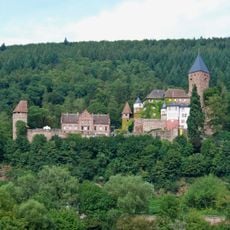
The nearby castle served as a setting for theatrical performances and musical gatherings that drew visitors from surrounding communities. Today, the canyon area remains connected to these cultural traditions through its role in regional events.
The path through the gorge is narrow and partly secured with steel cables as handholds; sturdy footwear is needed on the wet rocks and fallen trunks. After heavy rain or in the cold season, the lower valley floor away from the marked trail is difficult and unsafe to walk. A partly slipped path connects the mouth of the Schlossbächlein at the Neckar with the castle and the gorge trail.
The gorge is a protected geotope within the Neckartal-Odenwald Nature Park. Its name exists in two official spellings: the municipality of Zwingenberg writes Wolfsschlucht, while the Baden-Württemberg surveying office uses Wolfschlucht on its maps. The last wolf of the Odenwald is said to have been shot near here in 1866.
The community of curious travelers
AroundUs brings together thousands of curated places, local tips, and hidden gems, enriched daily by 93,819 contributors worldwide.