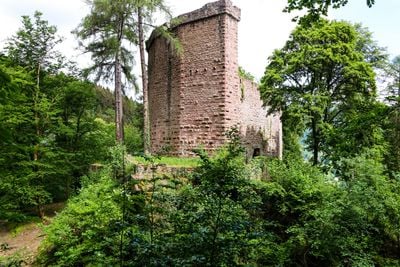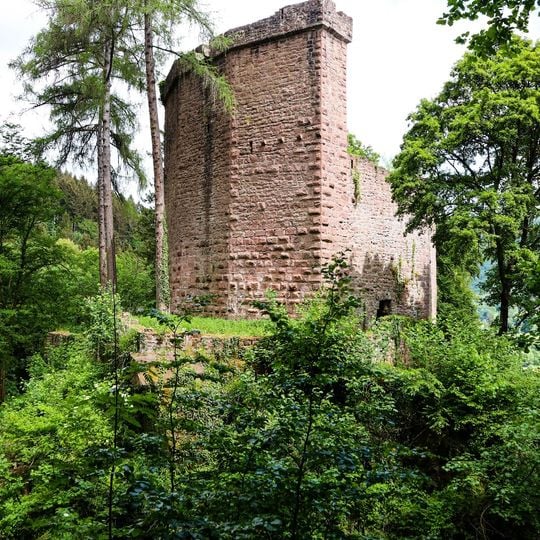
Burg Stolzeneck, Medieval castle ruin in Neunkirchen, Germany
Burg Stolzeneck is a ruined hill castle on a 215 m-high rock spur above the Neckar, about 2 km south of Eberbach-Rockenau. It consists of a core castle with a 21 m-high, 2.85 m-thick shield wall and a four-storey palas, surrounded by a zwinger and a bailey with a cistern. The core castle lies to the southwest, protected by a neck ditch; the bailey extends northeast down the slope.
Burg Stolzeneck was probably built around 1200 as an imperial castle. In 1284 Count Palatine Louis II acquired it, and it was then granted as a Palatine fief to ministerials. From 1418 to 1458 it was again held by the Palatinate; it was probably damaged in 1504 during the Palatine-Bavarian War of Succession. After the von Frauenberg family died out in 1610 it reverted to the Palatinate, was reported dilapidated in 1611 and abandoned; the associated hamlet of Krösselbach was given up too.
The name Stolzeneck was first recorded in 1268 with a widow von Stoltzinecke, before the Palatinate acquired the castle in 1284. The castle was a fief granted to service families, and its small associated estate included the hamlet of Krösselbach, minor holdings in Rockenau and fishing rights. The site was abandoned after 1610, and the hamlet's residents were resettled in Zwingenberg.
The ruin sits on a wooded rock spur about 80 metres above the northward-flowing Neckar, roughly 2 km south of Eberbach-Rockenau, on Neunkirchen's municipal land. The main access today is through an artificial opening in the west; the shield wall can be climbed. The site was only cleared of vegetation in the 1960s, so paths remain simple forest tracks.
Archaeological digs in 1964 uncovered foundation lines running diagonally that did not follow the palace walls. These findings suggest the fortress underwent rebuilding after 1350 and again during the 16th century.
The community of curious travelers
AroundUs brings together thousands of curated places, local tips, and hidden gems, enriched daily by 93,887 contributors worldwide.