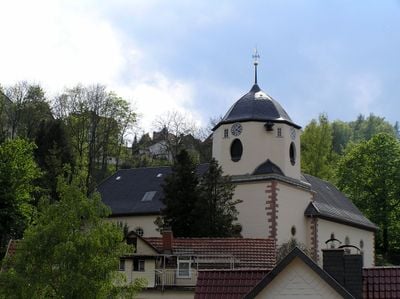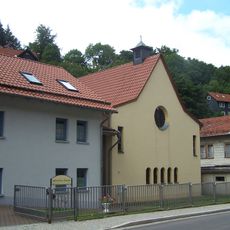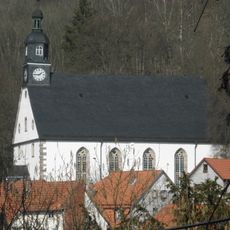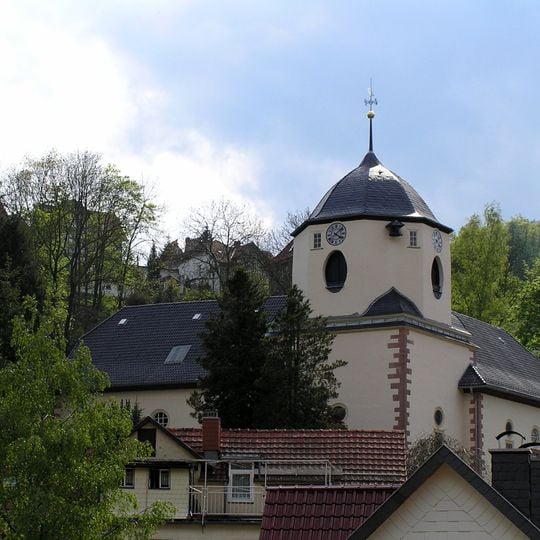
St.-Concordia-Kirche, Protestant church in Ruhla, Germany
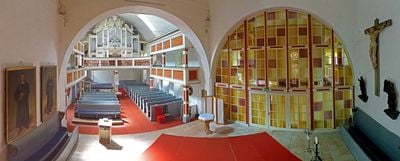
St.-Concordia-Kirche is a church building in Ruhla with an L-shaped floor plan. The south wing contains galleries on two levels, while a glass partition divides the western nave section.
Construction took place in 1661 under architect Johann Moritz Heinrich Richter from Weimar. The project was funded through community donations, demonstrating how important the building was to local residents.
The name Concordia, Latin for concord, was chosen to encourage unity between Ruhla's two town halves, which had quarrelled over rights to the Trinitatiskirche. The baptismal font was a gift of the Ruhla cutlers' guild and was originally made for St. Trinitatis across the valley. The 1911 organ by the Jehmlich brothers has 36 stops on two manuals and pedal, restored in 2011 by Orgelbau Kutter.
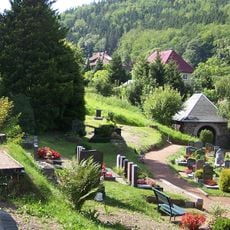
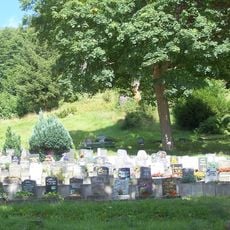
The west nave, separated by a glass wall in the 1980s, now serves as a parish hall used for events. The three bells hang not in the tower but in a separate bell house on the surrounding cemetery, a short distance from the church.
The three bells hang not in the tower but in a separate bell house on the surrounding cemetery. The large and small bells were cast in 1918 by Schilling & Lattermann in Apolda, and Lauchhammer foundry cast the third in 1998 to replace one that had cracked.
The community of curious travelers
AroundUs brings together thousands of curated places, local tips, and hidden gems, enriched daily by 94,644 contributors worldwide.