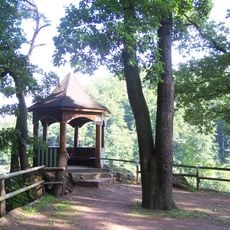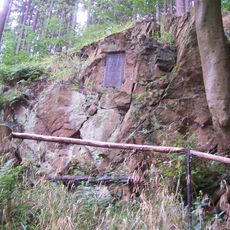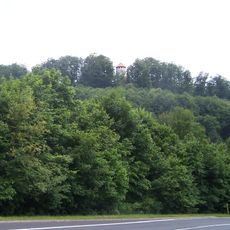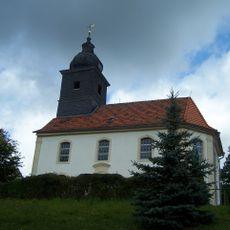
Scharfenburg, Medieval fortified tower in Ruhla, Germany.
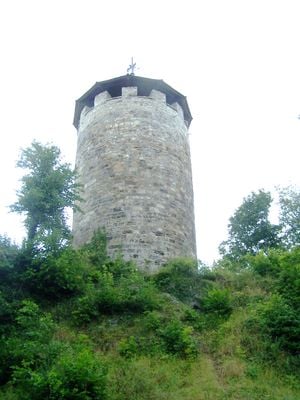
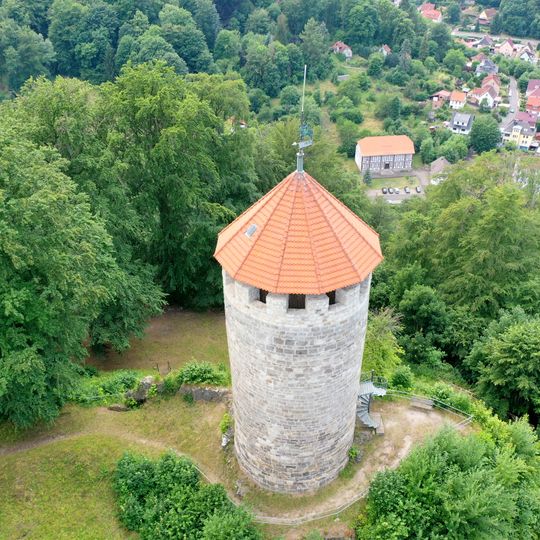
Scharfenburg is a ruined hilltop castle on the conical Scharfenberg above Thal. Its round bergfried, about 12 m in diameter with walls over 2 m thick at the base, was rebuilt to 20 m and is reached by an external steel spiral staircase. Below it, remains of ring walls, a wall-and-ditch system and a gatehouse with a Gothic portal and the Uetterodt coat of arms survive.
Scharfenburg was first documented on 13 September 1137, when Hartung von Scharfenberg appears as a witness in a charter for the hospital at Frauenbreitungen. In 1260 Hessian troops occupied it, followed by Wettin ministeriales. From 1446, after a siege in the Saxon Fratricidal War, it lay largely in ruins, and the von Uetterodt family built an administrative house in the valley instead.
The keep holds a small museum with selected finds and information panels on the castle's history, and a small stage in the centre of the courtyard is used for music and lectures. A castle festival is held every July within the walls, and a small log cabin built in 1997 serves the running of the ruin.
The main access is a narrow path starting at Am Rögis on the Scharfenberg, about 75 m above the valley floor. The keep is opened during the day by an automatic locking system; between May and September it is accessible from 9 am to 8 pm, from October to April from 10 am to 4 pm. An external steel spiral staircase leads up to the viewing platform.
The coat of arms of the von Uetterodt family still adorns the entrance gate, a reminder of their long rule from the 15th century until the 19th century. This visible marking shows how noble families displayed their power through such symbols.
The community of curious travelers
AroundUs brings together thousands of curated places, local tips, and hidden gems, enriched daily by 94,049 contributors worldwide.