St. Peters Church, Romanesque church in Bosau, Germany
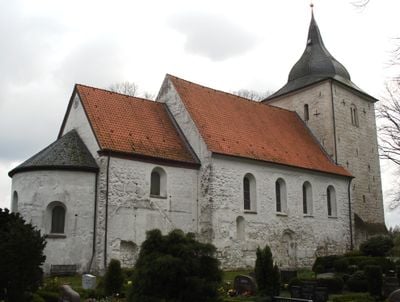
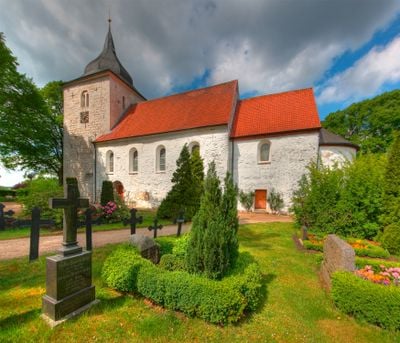
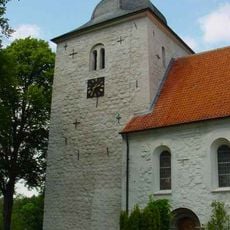
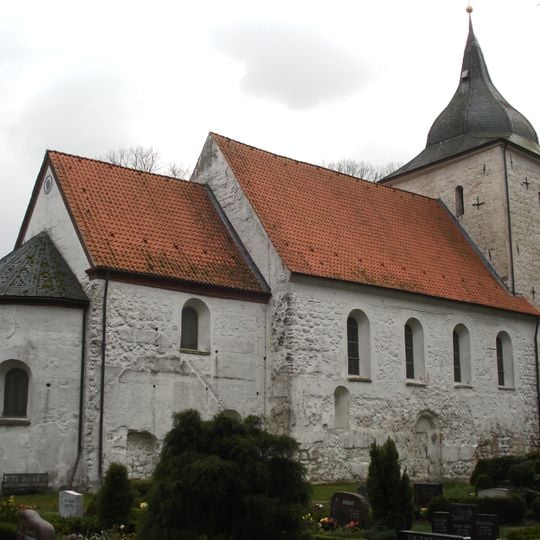
St. Peters Church in Bosau is a fieldstone church with a long nave, a lower apse with a conical roof, and a square tower topped by a curved spire. The walls, pierced by small round-arched windows, were originally coated in white gypsum mortar from the Segeberg chalk hill; a 1970 lime wash restored that white appearance. Fieldstones around the tower mark the foundations of a round predecessor destroyed in 1627.
Bishop Vicelin began building St. Peter's Church in 1151 with craftsmen and material from Segeberg and Neumünster; it was consecrated in 1152. Bosau was the seat of the Oldenburg diocese from 1150 to 1156, and the chronicler Helmold wrote his Chronica Slavorum here from 1167 to 1172. Around 1200 the three-aisled basilica was rebuilt as a hall church with a west tower, choir and apse.
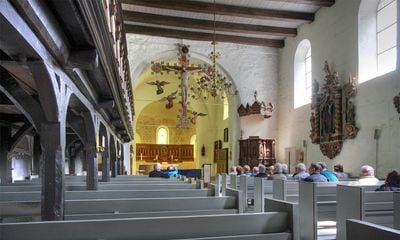
The church has hosted the Bosauer Sommerkonzerte for over 40 years. The name Bosau derives from the Slavic Bozowe, possibly meaning "among the beeches". Inside, a 1636 pulpit carries a small hourglass added at Christmas 1734 to time the sermon.
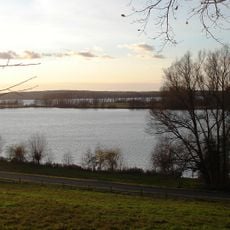
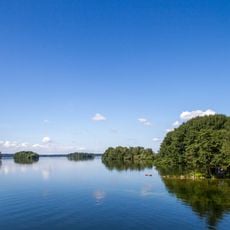
The church stands at the southern end of the Große Plöner See, on the Bosau peninsula that was once an island. The foundations of the original round tower are marked by fieldstones set in the ground around today's square tower, so look down as you approach. The Bosau summer concerts have been held here for over 40 years.
The church has been the main venue of the Bosau Summer Concerts for over 40 years. The 1972 Becker organ has 16 stops on two manuals and pedal. In 1916, restorers found five relics inside the head of the triumphal cross, each with a strip of parchment naming it.
The community of curious travelers
AroundUs brings together thousands of curated places, local tips, and hidden gems, enriched daily by 94,085 contributors worldwide.