Petrikirche, Protestant church building in Mülheim an der Ruhr, Germany
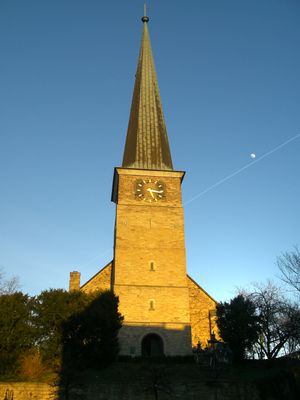
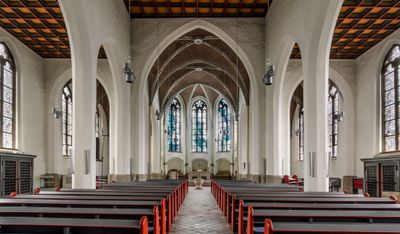
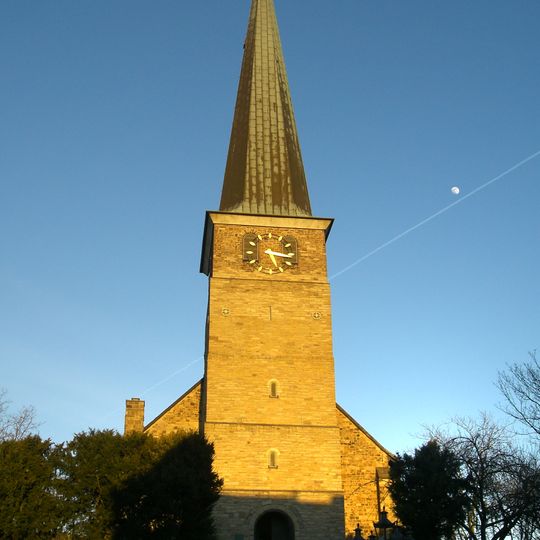
Petrikirche is a church on the Kirchenhügel in Mülheim an der Ruhr. Its four-storey west tower of coal sandstone, built around 1250, rises into a square belfry with a clock and a steep spire clad in weathered greenish-grey metal. The nave roof adjoins the tower on the left. Inside, white plaster walls carry pointed arches, and a wooden lattice ceiling of diagonal ribs spans the nave on dark tie rods. Three tall pointed-arched windows with dark patterned glass stand behind a pale stone altar platform with a cross; dark pews with bright red side panels line a central tiled aisle, and a pale stone font sits before the altar steps.
The Petrikirche grew from the chapel of the manor of the Lords of Mulinhem, first mentioned in 1093, and was rebuilt as a Romanesque church around 1200. Around 1250 a four-storey west tower of coal sandstone was added, and at the end of the 15th century a Gothic choir and a northern chapel extension. The nave was rebuilt in neo-Gothic style from 1870 to 1872, while tower and choir survived; after wartime destruction, Denis Boniver led the reconstruction from 1949 to 1958.
The church is used by the Vereinte Evangelische Kirchengemeinde for services and also for musical and other artistic events. The bronze reliefs on the portal doors, made by Rika Unger in 1959/60, show scenes from the life of the Apostle Peter, to whom the church is dedicated. The square around the church has been named Pastor-Barnstein-Platz since 1989, after Ernst Barnstein, pastor of the Bekennende Kirche here from 1922 to 1961.
The church stands on the Kirchenhügel, and the square around it has been named Pastor-Barnstein-Platz since 1989. The building is used by the Vereinte Evangelische Kirchengemeinde for services and for musical and artistic events, so visitors should check the parish's event notices before planning a visit.
Behind the organ, built from 1955 to 1959 by the Karl Schuke workshop to plans by organist Siegfried Reda, a small organ museum displays the old electromechanical setter as a technical monument. The instrument itself, with 59 stops, is protected for its voicing and fullness of sound.
The community of curious travelers
AroundUs brings together thousands of curated places, local tips, and hidden gems, enriched daily by 94,431 contributors worldwide.