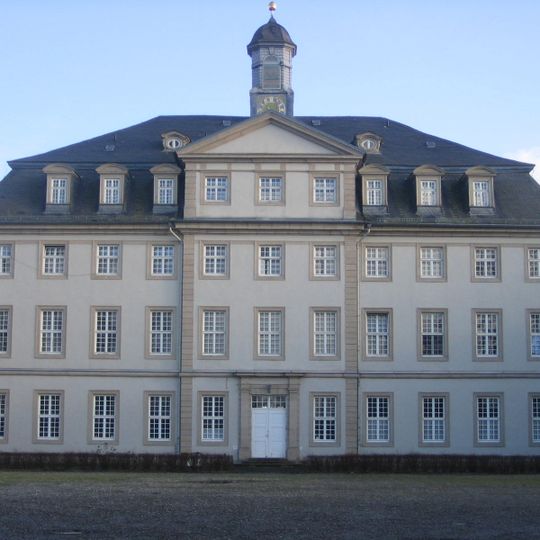
Jagdschloss Wabern, Baroque hunting lodge in Wabern, Germany.
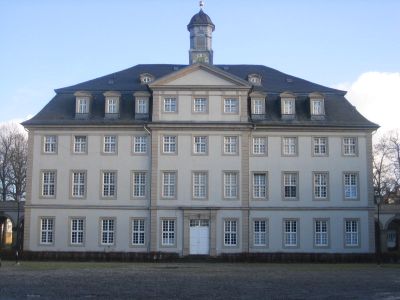
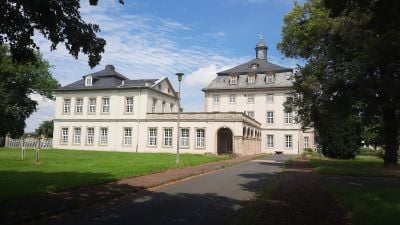
Jagdschloss Wabern is a three-storey Baroque building with a light grey facade divided by tan pilasters into a central block and side wings. The central block has a triangular pediment and a white double door, and above the cornice rises a steep hipped roof with dormer windows and a small square clock tower with a domed top and finial. A central risalit on the park side ends in a balcony decorated with medallions bearing relief heads of Landgrave Karl and his wife Maria Anna Amalia of Courland.
Landgrave Karl of Hesse-Kassel had the lodge built from 1704 to 1707 to designs by court architect Johann Konrad Giesler, for his wife Maria Anna Amalia of Courland. The marshy ground at the edge of the Eder floodplain was drained and supported on driven piles. Around 1770 Landgrave Frederick II had the side buildings linked by galleries built by Simon Louis du Ry, completing the horseshoe layout.
The name Karlshof honours Landgrave Karl, who built the lodge for his wife Maria Anna Amalia of Courland. Under Friedrich II the lodge hosted a June court camp and a falconry; herons were hunted with falcons in the nearby Reiherwald. Wall-sized paintings of the heron hunt by Johann Heinrich Tischbein the Elder are now in Fulda's Schloss Fasanerie.
The building now serves as a clinical facility and can be viewed from the exterior, though interior access may be restricted. Visitors should check in advance whether exterior photographs or limited tours are permitted.
Philosopher Voltaire stayed at the lodge for three days in May 1753 during his return journey to France while visiting Landgrave Wilhelm VIII. This brief encounter between the renowned French thinker and the German princely court was recorded in historical documents of the time.
The community of curious travelers
AroundUs brings together thousands of curated places, local tips, and hidden gems, enriched daily by 94,646 contributors worldwide.