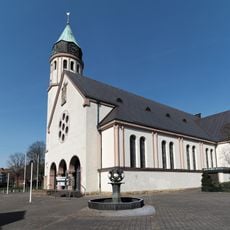
St. Antonius, Parish church in Castrop-Rauxel, Germany
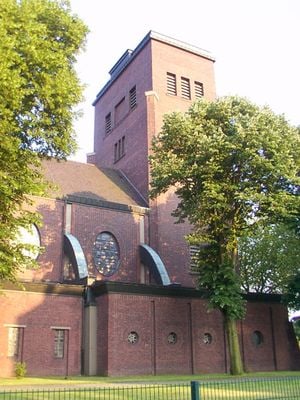
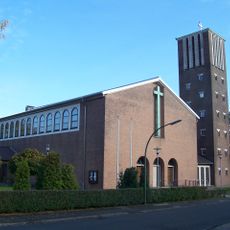
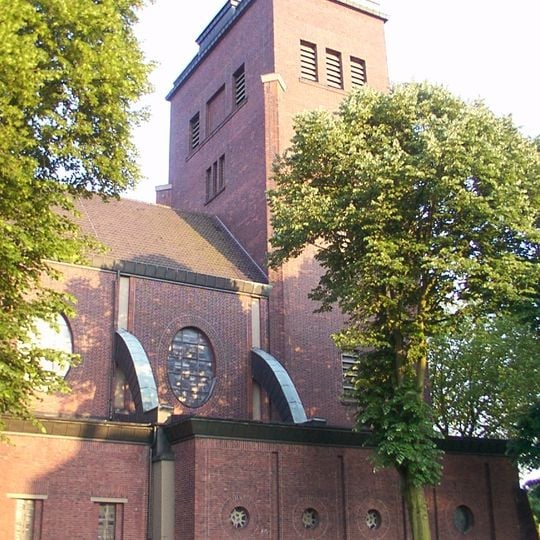
St. Antonius is a brick Expressionist church built 1922–1925 to a design by Alfred Fischer, his only sacred building. Outside it reads as a classic basilica with a nave and two aisles; inside, Fischer replaced right angles with parabolic arches, the nave shaped like a mining gallery. The 15 m wide hall reaches 17.5 m at its apex, built with the then-new Rabitz wire-mesh plaster technique.
The church was designed by architect Alfred Fischer in the early 20th century and realized traditional ecclesiastical building principles. The building was later designated as a protected monument representing the religious architecture of that era.
The parish grew from a mining settlement: after shaft Ickern 1/2 opened, the Catholic community rose to 7,600 within the mother parish of St. Remigius in Mengede. Since 2015 St. Antonius has been a filial church of the Corpus Christi parish, whose only parish church is St. Josef in Habinghorst. The four former parishes of Castrop-Rauxel North still share one procession at Corpus Christi.
The building is open to visitors during service times and designated opening hours to view the architecture and interior spaces. Check ahead to confirm visiting times before your trip to avoid disappointment.
The tower's shape borrows from the boiler house Alfred Fischer designed for the Victor 3/4 colliery, and the nave takes the form of a mining gallery. Inside, the parabolic arches were built with the Rabitz wire-lath plaster method, allowing a 15 m span and 17.5 m crown height. The four cast-steel bells were cast in 1925 by the Bochumer Verein and tuned to a°-cis'-e'-fis'.
The community of curious travelers
AroundUs brings together thousands of curated places, local tips, and hidden gems, enriched daily by 94,113 contributors worldwide.