Scherkondetalbrücke, Railway bridge in Thuringia, Germany
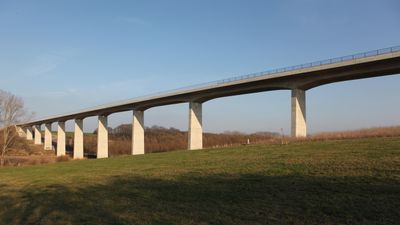
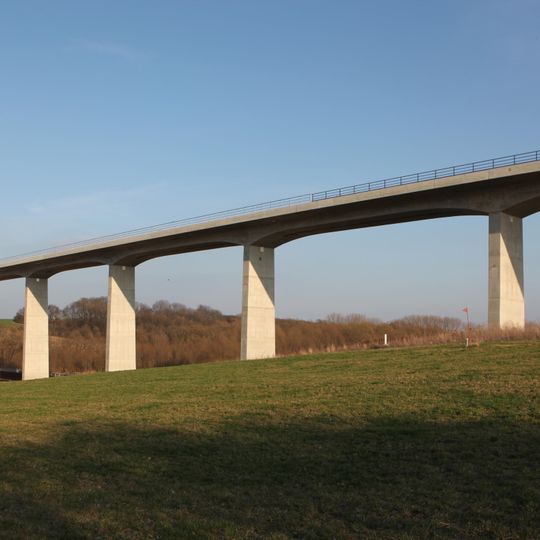
The Scherkondetalbrücke is a railway bridge made of prestressed concrete that spans the Scherkonde valley with seven elongated beams. The structure eliminates central supports and is carried from both sides, giving it a slender profile.
The bridge was built in 2011 as part of the high-speed rail line connecting Erfurt to Leipzig and Halle. It represented an important advancement in the modernization of Germany's railway network during that period.
The bridge demonstrates how modern engineering creates transport routes across challenging terrain. Visitors can see a practical solution to an everyday problem: building a stable crossing without intrusive support pillars in the valley.
The bridge can be viewed from the road near the village of Scherkondetal, but it is not directly accessible to pedestrians along a path. It is best appreciated by rail and engineering enthusiasts who can approach it from existing viewpoints in the area.
The structure was built without central pillars, which represents a notable engineering achievement for a valley of this size. This created a rare type of bridge where all loads are carried from the two end supports.
The community of curious travelers
AroundUs brings together thousands of curated places, local tips, and hidden gems, enriched daily by 90,819 contributors worldwide.