Travertinpark, Public park in Bad Cannstatt, Stuttgart, Germany
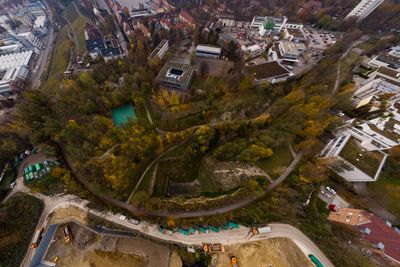
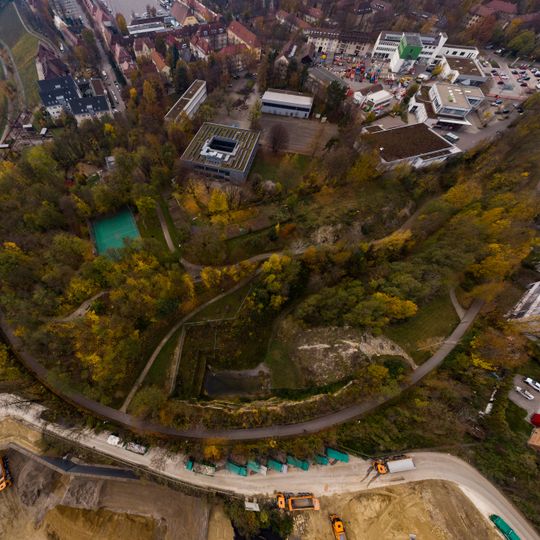
Travertinpark is a park on a wooded slope in Hallschlag, in Stuttgart's Bad Cannstatt district, laid out over the quarries of the Cannstatter travertine. Light footpaths wind through trees, with a sports court and a flat-roofed building at the upper edge and a small basin in a clearing below. The gravel bed of the disused Münster–Cannstatt industrial railway runs across the grounds, where a switch and a level crossing survive.
Three quarries extracted Cannstatt travertine within today's park: those of Lauster, Schauffele and Haas. Schauffele's pit was later backfilled, but its historic crane runway, restored in 2008, survives. Haas's quarry, worked until 2007, is now part of the path network; its stone went into Nuremberg's Märzfeld and the facade of Stuttgart's Mittnachtbau. The park opened on 19 May 2010, and its core reopened in late September 2014 after 14 months of rebuilding.
The 14 travertine columns, each 15 metres high and carved in the Tuscan order, stand between the two covers of the Stuttgart-Münster power station, outside the park itself. Berlin ordered them in 1936 from the Lauster quarry for the lower storey of a monument to Mussolini on today's Theodor-Heuss-Platz. Never collected, they were bought back by Lauster after the Second World War.
The park is accessible via two transport stations: Kraftwerk Münster on line U14 or Bottroper Straße on line U12, both with short walking distances to the entrance. Paths throughout the site are clearly marked and easy to navigate.
The park is a designated excavation protection area: fossils of forest rhinos, forest elephants and pond turtles, plus flint tools pointing to early humans, have been found in the Cannstatt travertine quarries. Parts of these finds are displayed in the State Museums of Natural History in Stuttgart.
The community of curious travelers
AroundUs brings together thousands of curated places, local tips, and hidden gems, enriched daily by 93,726 contributors worldwide.