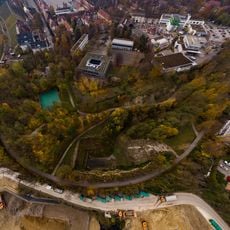
Eisenbahnviadukt Stuttgart-Münster, Railway viaduct in Bad Cannstatt, Germany.
The Stuttgart-Münster Railway Viaduct is a reinforced concrete bridge on the Untertürkheim–Kornwestheim freight bypass line, crossing the Neckar valley between Bad Cannstatt and Münster near the Münster power station. It stands 30 metres high and also spans the U14 Stadtbahn line and the disused Münster–Cannstatt industrial railway. The old König-Wilhelms-Viadukt, an iron truss structure on masonry piers, remained in service until 1990.
The first bridge here, the König-Wilhelms-Viadukt, opened in 1896 as a steel truss structure on masonry piers, named after Wilhelm II, who inaugurated it himself. It was blown up shortly before the end of the Second World War and returned to service in 1954. From 12 December 1984 a reinforced concrete replacement was built alongside; the last train crossed the old viaduct on 10 February 1990.
The railway bridge shapes the neighborhood's character and represents the industrial past of Bad Cannstatt. It serves as a daily landmark for residents and reflects the area's transportation importance.
The bridge crosses the Neckar valley beside the Münster power plant. On the left bank, the Neckartalstraße runs beneath it, with the U14 stops "Kraftwerk Münster" and "Münster Viadukt". About 400 metres from the river it also passes over the U2 and U19 tracks between "(Bad Cannstatt)-Kursaal" and "Gnesener Straße".
One original pier of the old König-Wilhelms-Viadukt survives and has been opened as an artificial climbing wall, supervised by the Stuttgart section of the German Alpine Club. The 1896 steel truss bridge it belonged to was the largest of its kind in the Kingdom of Württemberg and was inaugurated by Wilhelm II himself.
The community of curious travelers
AroundUs brings together thousands of curated places, local tips, and hidden gems, enriched daily by 92,847 contributors worldwide.