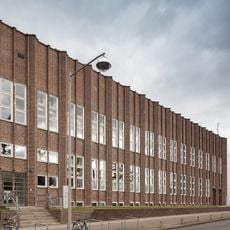
Stichweh-Wohnhaus, Architectural heritage monument in Hanover-Nordstadt, Germany.
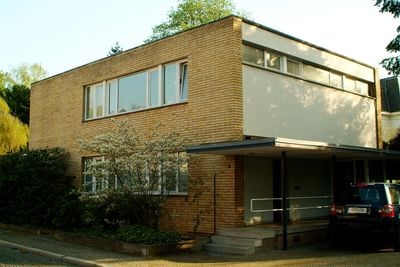
The Stichweh-Wohnhaus is a two-storey cubic house with a flat roof at Alleehof 4 in Hanover's Nordstadt, in a villa quarter near the Herrenhäuser Gardens. Its facade alternates yellow brick and plaster surfaces, with narrow window bands and an entrance canopy carried on thin metal columns. Behind cabin-like vestibules lies a large living area.
Renowned architect Walter Gropius designed this residential building between 1952 and 1953 as his first post-war construction project in Germany. It was also his sole work in Hanover and represented a statement for the revival of modern architecture in the post-war period.
Today the building functions as an exhibition space and offices for the Association of German Architects BDA Lower Saxony and the Architecture Promotion Association. Visitors can experience regular exhibitions and events that showcase the work of contemporary and international design practices.
The building sits in a quiet residential neighborhood with good access through its proximity to the Herrenhäuser Gardens and other cultural institutions. Visitors should note that it is an actively used office building, so it is worth checking in advance if exhibitions or events are open to the public.
The house has stayed in the Stichweh family since it was built and is rented to the BDA. On 28 June 2013, Klaus Stichweh, son of the client Wilhelm Stichweh, returned to Hanover to speak with building historian Sid Auffarth about the house's early years, during the BDA's 60th anniversary celebrations.
The community of curious travelers
AroundUs brings together thousands of curated places, local tips, and hidden gems, enriched daily by 94,491 contributors worldwide.