Stiefel, Natural sandstone monument in Sankt Ingbert, Germany.
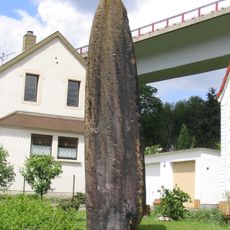
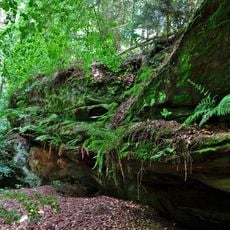
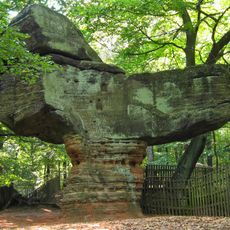
Stiefel is a sandstone formation with red layers that rise like a tabletop from the surrounding forest near Sankt Ingbert. The structure consists of multiple stacked rock beds that were shaped over time through natural erosion and weathering.
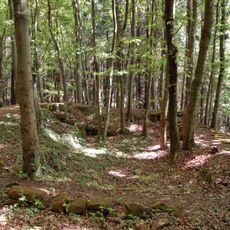
Flint blades, arrowheads, grinding stones and stone axes from the Mesolithic period (8000–4000 BC) were found on the Großer Stiefel ridge, suggesting the rock already served ritual purposes in the Neolithic. In the 10th century a castle, the Stiefler Schloss, was built on the ridge; remains of walls, earthworks and ditches are still visible. The Stiefelhütte, also called Heinrich-Kohl-Hütte after a founding member of the Pfälzerwald-Verein, was built in 1912, burned down in 1983 and was rebuilt immediately by the association.
The distinctive shape of this sandstone formation inspired the creation of Ingo, a cartoon character that became a symbol of Sankt Ingbert's identity. Local residents use this landmark as a point of reference when describing their town.
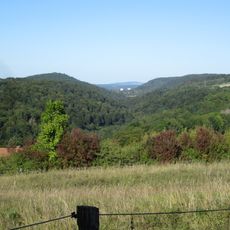
The rock stands at about 350 m on the northeast slope of the wooded Großer Stiefel ridge (397.2 m) between Rentrisch and Sengscheid. The shortest approach is from the Stiefel car park in Sengscheid; the A6 motorway and its St. Ingbert-West junction run east of the hill. Since 2023 a permanent metal fence surrounds the monument, so it is viewed from outside.
The rock gives its name to the whole 397.2 m ridge, the Großer Stiefel, though name researcher Hermann Albert Prietze linked the name to a Thingstapel, a judicial column, as with the Stiefelberg near Reichartshausen. The lower part has weathered into a column about 6 m in circumference that carries the upper block.
The community of curious travelers
AroundUs brings together thousands of curated places, local tips, and hidden gems, enriched daily by 95,118 contributors worldwide.