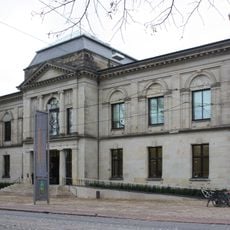
Theater am Goetheplatz, Protected heritage theater in Bremen-Mitte, Germany.
Theater am Goetheplatz is the largest venue of Theater Bremen, standing on the north side of Goetheplatz at the western exit of the Ostertorsteinweg. The 1912–1913 building by August Abbehusen and Otto Blendermann is Neoclassical, with a colonnade facade; the 1950 reconstruction raised the colonnade, removed the hipped roof and simplified the column capitals, giving it a more austere look. It seats up to 868.
The Schauspielhaus am Ostertor opened on 15 August 1913 with Oscar Wilde's Eine Frau ohne Bedeutung, built by August Abbehusen and Otto Blendermann for the private Bremer Schaubühne. It replaced the Schauspielhaus am Neustadtswall, where the Modernes now stands. After wartime destruction, the preserved foundation walls and column facade were rebuilt by Werner Commichau and Hans Storm, reopening on 27 August 1950 with Goethe's Egmont.
The name of the house refers to Goetheplatz, the square in front of the building, which is itself named after Johann Wolfgang von Goethe. Anyone attending a performance passes through a public space that was deliberately linked to German literary tradition.
The theater sits in the heart of the city center and can easily be reached on foot from most points in the downtown area. Several restaurants and cafes around Goetheplatz make it straightforward to plan a meal before or after a show.
The theatre's stage was pushed back during the post-war rebuild to enlarge the orchestra pit and raise capacity, and a revolving stage was installed. In 2007 the magazine Opernwelt named it Opera House of the Year. The building has been a listed monument since 2005.
The community of curious travelers
AroundUs brings together thousands of curated places, local tips, and hidden gems, enriched daily by 94,109 contributors worldwide.