Talsperre Werda, Reservoir in Vogtlandkreis, Germany
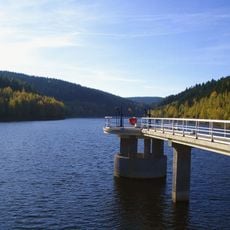
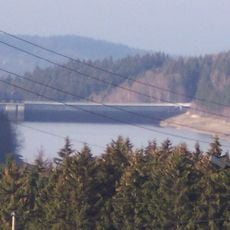
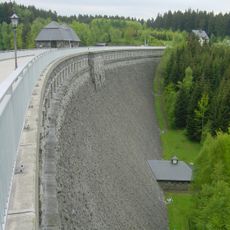
Talsperre Werda is a curved, jointless gravity dam of local fractured schist masonry built on the Intze principle, holding back the Geigenbach stream in the Geigenbachtal near Werda. The wall was raised by 3 m between 1989 and 1990 and given a water-side concrete facing, bringing storage to about 5 million m³. A smaller pre-dam serves as an operating water reservoir.
Plauen built the reservoir between 1904 and 1909 and put it into service in 1910, after its population had doubled between 1896 and 1904 and the existing waterworks could no longer meet demand. From 1911 it supplied drinking water to Plauen and the surrounding area and also served flood control. About 450 workers took part, among them Italians and Croatians, at a cost of roughly 7 million marks.
The reservoir's name comes from the Geigenbach stream it dams, and it is also called the Geigenbachtalsperre. Among the roughly 450 workers on the 1904–1909 site were Italians and Croatians. The reservoir has supplied Plauen's drinking water since 1911, and the Geigenbach flows on as the Trieb to feed the larger Pöhl reservoir.
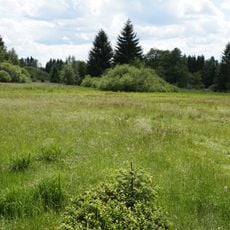
Swimming and water sports are not allowed on the water, but walking paths circle the entire area. Wear sturdy shoes and bring a map to explore the various routes around the reservoir.
The reservoir's water comes from the Geigenbach, which further downstream, under the name Trieb, feeds the much larger Pöhl reservoir. Since 1965 a pump station below the Zahnmühle has also fed the reservoir from a nearby stream, and a pumping line can carry water from the Muldenberg reservoir about 7 km away.
The community of curious travelers
AroundUs brings together thousands of curated places, local tips, and hidden gems, enriched daily by 93,787 contributors worldwide.