Burg Falkenstein, Medieval castle in Falkenstein, Germany.
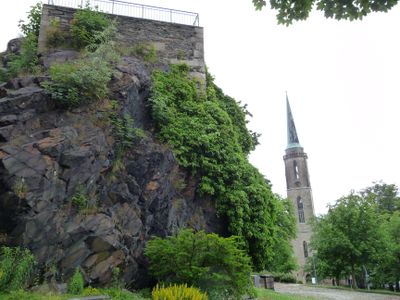
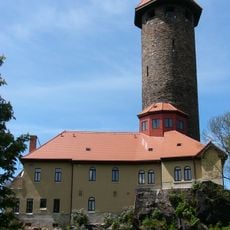
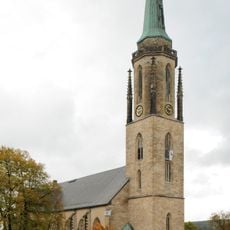
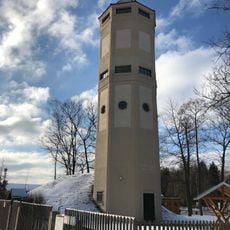
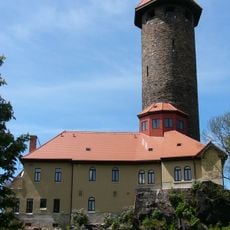
Burg Falkenstein is the remnant of a rock castle on a crag above the Church of the Holy Cross in central Falkenstein, Saxony. Its summit was levelled with retaining walls into a trapezoidal platform holding the eight-by-eight-metre stump of a square tower, now railed off as a viewing point; there was little room for other buildings.
Burg Falkenstein was built around 1200 by the Vögte of Weida and Plauen as part of a chain of castles guarding the cleared Plauen territory to the east. It was enfeoffed to the Falkenstein family, documented in 1267 with Johannes von Falkenstein. After the Vogtland War the Falkensteins had to grant King Charles IV the right of opening; by the late 14th century the castle passed to the Wettins. In 1618 Georg Abraham Trützschler had the already decayed castle largely demolished.
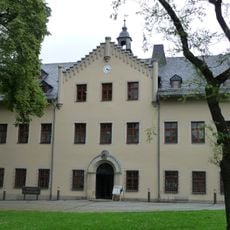
The name Falkenstein comes from the noble family of the same name, documented in 1267 with Johannes von Falkenstein as a follower of Heinrich I of Plauen. The family died out around the end of the 14th century, when the castle passed to the Wettins. The Trützschler lords, enfeoffed in the first half of the 15th century, built the Schloss at the foot of the rock and expanded the settlement into a town.
The castle ruins are freely accessible during daylight hours with no entrance fees. Wear sturdy footwear as the ground is uneven and some areas may be slippery or unstable.
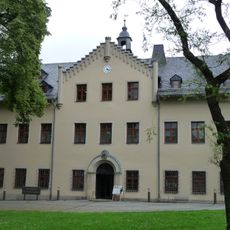
The "Schlossmauer" next to the later castle at the foot of the rock was built in the 18th and 19th centuries from demolition material. It contains large Staufer-era granite boss blocks, attributed to the former Romanesque palas of the 12th century; such a find is unique in the Vogtland district.
The community of curious travelers
AroundUs brings together thousands of curated places, local tips, and hidden gems, enriched daily by 92,784 contributors worldwide.