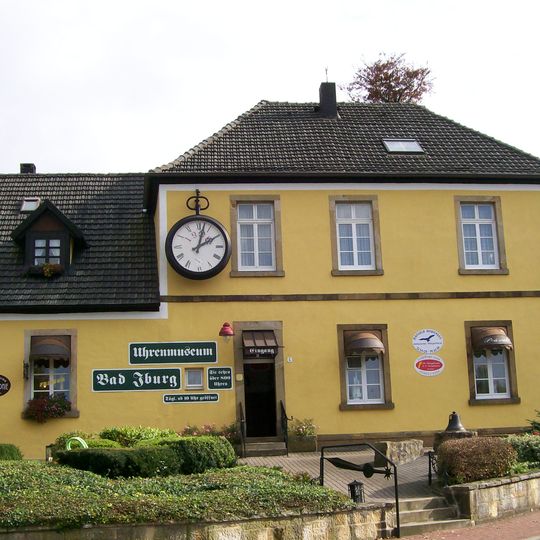
Uhrenmuseum Bad Iburg, Clock museum in Bad Iburg, Germany
The clock museum is located in a building from 1820 and houses more than 800 working timepieces across its rooms. The collection ranges from tower clocks to pocket watches and spans many centuries of timekeeping design.
The museum holds a French sundial made in 1470, which is the oldest timekeeping instrument in its collection. This artifact demonstrates how early the pursuit of precise measurement began.
Among the roughly 800 working timepieces are 17 tower clocks, including one from 1688 with a spindle escapement, one from 1723 with a scissor escapement and a church clock from 1848 with a Graham escapement. Later tower clocks come from Korfhage & Söhne of Buer near Melle. A French noon cannon sundial of 1800 woke people with a loud bang.
The museum occupies a building from 1820. The entrance is not wheelchair accessible, so visitors with mobility impairments should plan accordingly. The collection is spread over several rooms, and the largest pocket watch hangs outside on the facade, visible without a ticket.
The oversized pocket watch on the facade, 1.80 metres across and 150 kilograms, is radio-controlled and listed in the Guinness Book of Records. It is the largest pocket watch of its kind in the world.
The community of curious travelers
AroundUs brings together thousands of curated places, local tips, and hidden gems, enriched daily by 94,361 contributors worldwide.