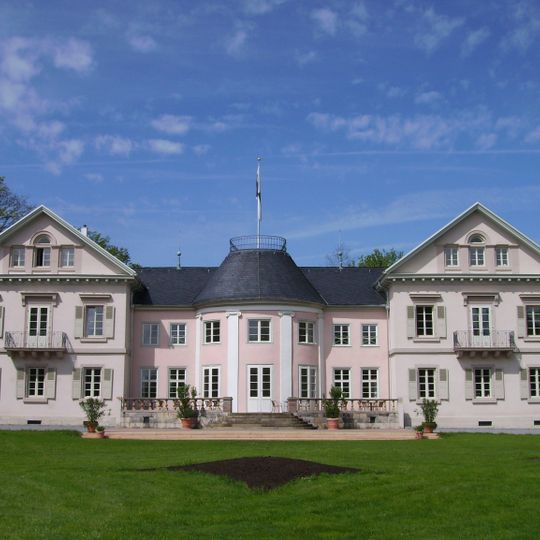
Villa Eugenia, Classicist villa in Hechingen, Germany
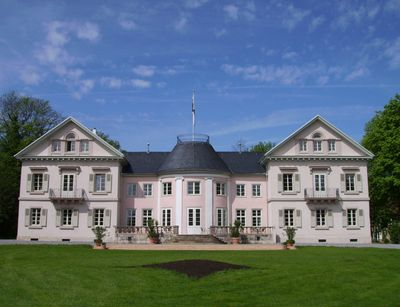
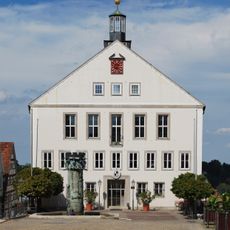
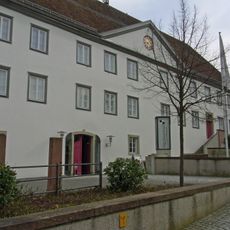
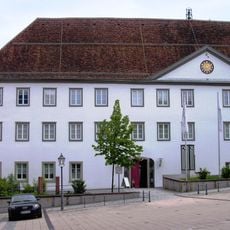
Villa Eugenia is a late-classicist villa in Hechingen, built in 1786/87 as a garden house and enlarged in 1833–34 with two two-storey side wings. The original domed roof was replaced by a tent roof with a platform, and the round central risalit was given wall pilasters instead of vase ornaments. The side wings carry a simple stucco frieze.
The building was erected in 1786/87 as a Lustgartenhaus for Prince Josef Friedrich Wilhelm, following designs by E. A. von Lammerz. In 1833–34 it was enlarged for the hereditary prince's couple with two side wings, financed by Eugénie de Beauharnais, who sold her Schloss Eugensberg for 32,000 Gulden. The villa is named after her. In 1850 the official handover of the principality to Prussia took place here.
Under Prince Konstantin, the last ruler of Hohenzollern-Hechingen, the villa was the centre of court cultural life in the first half of the 19th century. In 1838 Amélie von Leuchtenberg, former Empress of Brazil and sister of Eugénie, stayed as a guest. The name Eugenia goes back to Eugénie de Beauharnais, who financed the 1833 extension by selling her Schloss Eugensberg for 32,000 Gulden.
The building stands in the Fürstengarten south of Hechingen's old town, opposite the Villa Billing. Since the 2007 renovation it hosts cultural and private events, and the city runs a branch registry office (Standesamt) here. Access to the park is separate from access to the building's event rooms.
In the English-style Fürstengarten stands a billiards house built as a Greek anta temple, originally called the White House. The park also holds an orangery of 1837, a kitchen building of 1839 and the Villa Silberburg, a former inn that Princess Eugénie converted in 1844 into a summer house with a pergola of Doric columns.
The community of curious travelers
AroundUs brings together thousands of curated places, local tips, and hidden gems, enriched daily by 93,855 contributors worldwide.