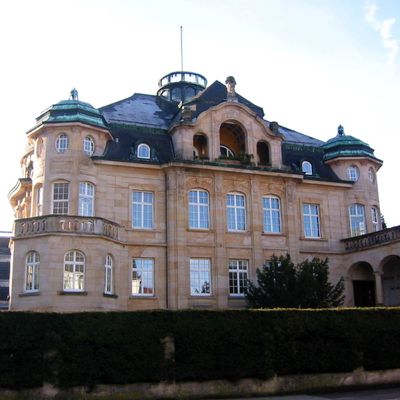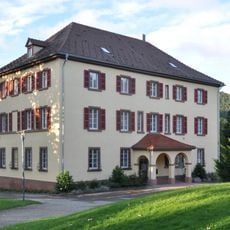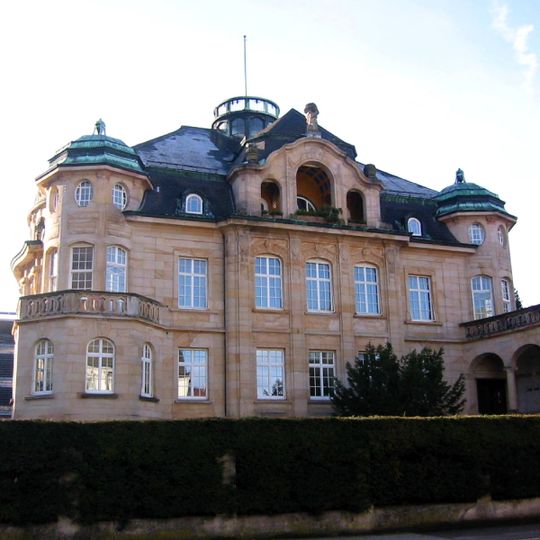
Villa Haux, Art Nouveau villa in Ebingen, Albstadt, Germany
Villa Haux is a yellow sandstone mansion built in 1908 by Stuttgart architects Richard Böklen and Carl Feil, mixing Historicism with Art Nouveau. Its executed plan separates a representative area from the living rooms, and its interior included wall paintings by Maria Caspar-Filser and Christian Landenberger's Der Frühling.
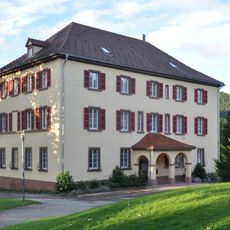
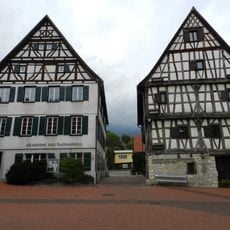
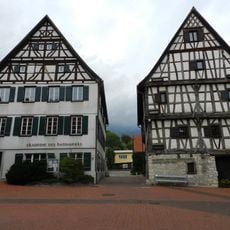
Friedrich Haux founded his knitwear factory Friedrich Haux & Cie. in 1885 and had a timber-framed house built on the site, decorated neo-baroque in 1898. When the Talgangbahn railway cut through the grounds in 1901, the old villa was moved across the street on railway tracks in 1907 to clear space. The new Villa Haux followed in 1908, built by Egon Diemer to plans by Richard Böklen and Carl Feil. The Haux family lived in both houses until 1954.
The villa's name comes from Kommerzienrat Friedrich Haux, the textile manufacturer who had it built. Since 1994 the Klaiber tax advisory firm has gradually acquired, restored and used it as offices and flats, and its reception rooms can now be hired for business or cultural events. The old villa next door has housed the Wirtshaus zum Trödler pub since 1991.
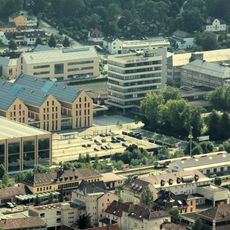
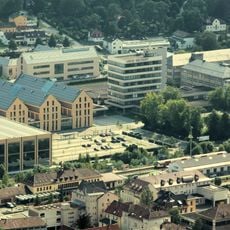
The Neue Villa Haux is owned by the Klaiber tax advisory firm, which uses it as offices and apartments; its representative rooms can be booked for business or cultural events. The building is a listed monument, and its historic wooden roller shutters were restored in 2019. The former factory next door now houses Albstadt-Sigmaringen University laboratories and, since 2012, a student cultural centre in the basement.
The 1907 plans still showed a luxurious family home, but the finished 1908 building was altered to give a large reception area largely separate from the living rooms. It also had an electric passenger lift, a stationary central vacuum system and a coal-fired low-pressure steam heating system.
The community of curious travelers
AroundUs brings together thousands of curated places, local tips, and hidden gems, enriched daily by 93,360 contributors worldwide.