Wasserschloss Taufkirchen, Moated castle in Taufkirchen, Germany.
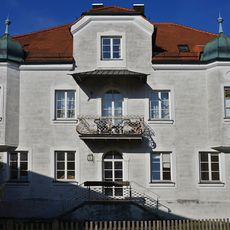
Wasserschloss Taufkirchen is a moated castle standing 200 m northeast of the parish church of St. Pauli Bekehrung in Taufkirchen (Vils). Its three-storey main building, built in 1676 on medieval foundations, has corner towers, volute gables and flanking pavilions, and was remodelled in Neo-Renaissance form in 1898. Terraces with a balustrade and a castle bridge over the moat, which dates from the end of the 17th century, lead to the entrance.
The castle is first recorded in 1263, when a document names a dispute between Bishop Conrad II of Wittelsbach and Grimold von Taufkirchen over rights to the site, described as "iuxta castellum eius". The Lords of Fraunberg followed, then the Fuggers held it from 1554 to 1672 and added a chapel whose altar bears their coat of arms. After the Barons of Puech, the Bavarian state used the building for hospital patients until 1998; the municipality bought it from Nico Forster's heirs in 2016.
The castle chapel added by the Fuggers has an altar bearing their coat of arms. Since the mid-1990s the castle has hosted cultural events, and today it also houses the Erding district music school, the OASE kindergarten and the municipality's civil wedding ceremonies.
The castle stands 200 metres north-east of the parish church of St Pauli Bekehrung. A bridge crosses the moat, whose present course dates from the end of the 17th century, leading to terraces with a balustrade. The building is used for cultural events, the district music school, a kindergarten and civil weddings, so parts are not open to casual visitors.
The chapel altar carries the Fugger coat of arms, a reminder of the family that owned the castle from 1554 to 1672 and expanded the original building. The castle was sold in 2005 for a symbolic one euro, on condition that the buyer restore it and open parts to cultural use.
The community of curious travelers
AroundUs brings together thousands of curated places, local tips, and hidden gems, enriched daily by 93,875 contributors worldwide.