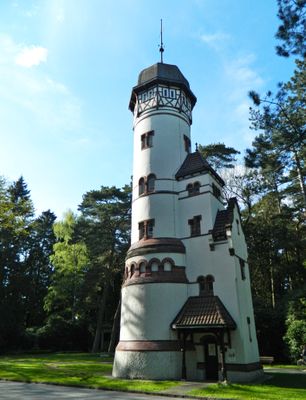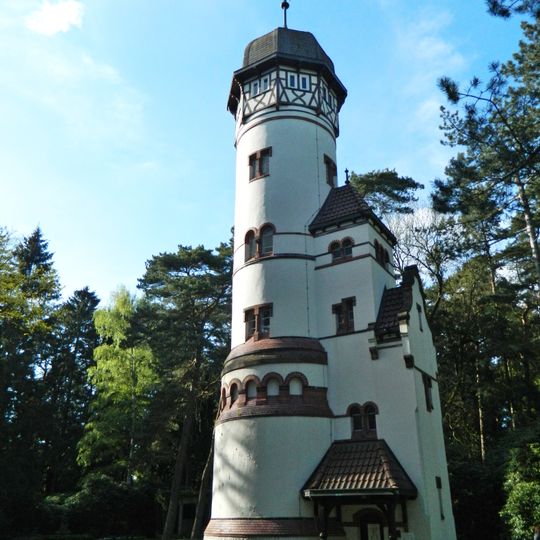
Ohlsdorf Cemetery water tower, Water tower in Ohlsdorf Cemetery, Hamburg, Germany.
The Ohlsdorf Cemetery water tower stands on Cordes-Allee in the older, elevated part of the cemetery. The 34-metre tower, designed by cemetery builder Wilhelm Cordes and erected in 1898, has a historicist form resembling a sacred building or part of a castle. It held two tanks: a 100 m³ low-pressure tank below and a 12 m³ high-pressure tank 18 m above ground. A stone spiral staircase in the attached stair tower leads to the middle level; an iron staircase originally continued through the upper tank to the viewing platform.
Wilhelm Cordes, the cemetery's builder and later director, designed the tower, built in 1898 when it stood at the cemetery's eastern boundary. The cemetery had its own water supply since 1879, with two pumping stations drawing from wells and the North Pond. Demand outgrew the wells, so in 1919 the cemetery was connected to the city water network; the tower's own supply was abandoned in the 1920s.
The tower was originally built to support the cemetery's operations and maintenance needs rather than for the surrounding city. This shows how large cemeteries functioned as self-contained communities with their own water and service systems.
The tower sits within the vast cemetery grounds and is easy to spot when walking around the site. Visitors can use it as a reference point for navigation or to get a sense of the cemetery's true size and layout.
The tower's upper high-pressure tank held only 12 m³, 18 m above ground, while the lower low-pressure tank held 100 m³. During World War II the large tank was converted into an air-raid shelter, and in 1941 the roof was removed and replaced with a temporary one. Since 2003 the Garten der Frauen e.V. association has used the tower, opening it to the public on Sunday afternoons in summer.
The community of curious travelers
AroundUs brings together thousands of curated places, local tips, and hidden gems, enriched daily by 93,367 contributors worldwide.