Wilhelmsgymnasium, Renaissance Revival educational institution in Lehel, Munich, Germany.
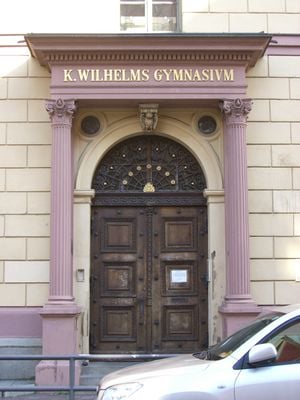
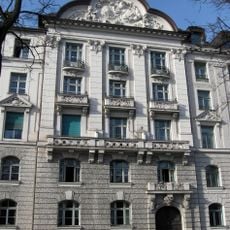
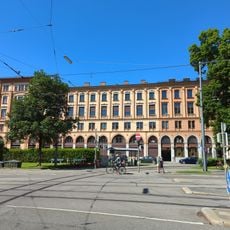
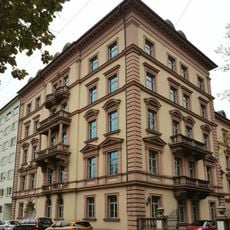
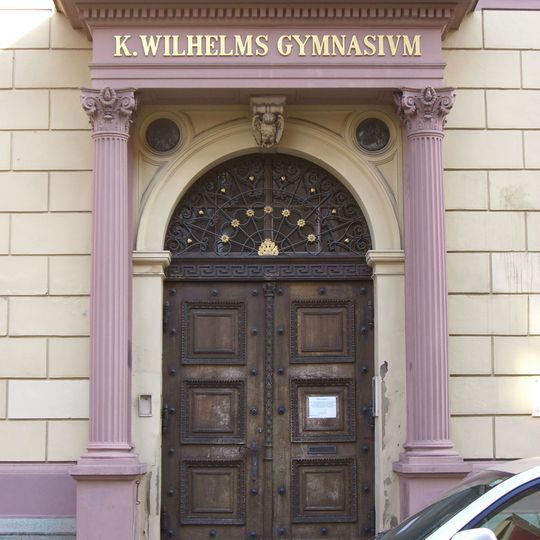
Wilhelmsgymnasium is a school building on Thierschstraße at the corner of Maximilianstraße in the Lehel district, built 1875–1877 to plans by Carl von Leimbach in Neo-Renaissance style. Its cream stone facade has a rounded arch on two fluted pinkish-mauve columns, a black wrought-iron grille with gold rosettes, and dark wooden double doors under a Greek-key band. The gold inscription "K. WILHELMS GYMNASIVM" runs across the lintel.
Founded in 1559 by Duke Albrecht V as a Paedagogium, the school was run by the Jesuits until their suppression in 1773. It was renamed in 1849 after Wilhelm V, and after moves via the Alter Hof and Herzogspitalstraße 18, Karl von Leimbach built the present Lehel building in 1875–1877 with support from King Ludwig II. Badly damaged in the Second World War, it was rebuilt in altered form in 1952–1958.
The school's name honours Duke Wilhelm V, who sponsored it; from 1849 it was called after him. Its library, grown since the Jesuit college of 1559, holds about 11,000 volumes, including early printed works and first editions of classical authors. Two neo-Latin poets, Jakob Bidermann and Jakob Balde, taught here.
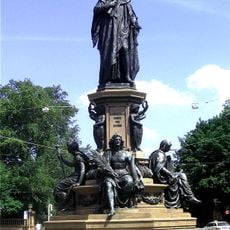
The school stands at Thiersstraße 46, on the corner of Maximilianstraße by the Maxmonument, with the Bavarian state parliament and the English Garden within walking distance. It is a working school, so the building is not open to the public; the Neo-Renaissance facade and the gilded portal inscription can be seen from the street.
The historic building underwent complete renovation between 2015 and 2018 while classes moved to temporary locations elsewhere. The fully updated facility now merges contemporary school resources with the preservation of the classical architectural heritage.
The community of curious travelers
AroundUs brings together thousands of curated places, local tips, and hidden gems, enriched daily by 93,664 contributors worldwide.