Wallenburg, Medieval castle ruins in Brotterode-Trusetal, Germany.
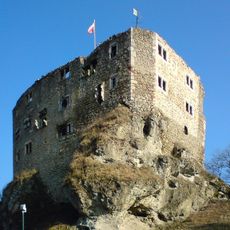
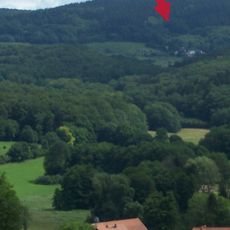
Wallenburg is the ruin of a hilltop castle on the 523.8 m Heinberg, also called Hühnberg, above the Auwallenburg district of Brotterode-Trusetal. The donjon, the entrance and the surrounding wall survive; the tower was restored in 1964–1965 and gives a wide view over the Werratal nature park and the Rhön. Its stones were quarried in the 16th century for Wilhelmsburg in Schmalkalden.
The fortress was built around 1200 to control the old trade route linking Herrenbreitungen to the Rennsteig pass. It played a role in managing local territories and their boundaries during the medieval period.
The name Wallenburg derives from "Waldenburch", first recorded in 1249 in a settlement between Ludwig III of Frankenstein and the Herrenbreitungen monastery. The castle was held jointly as a Ganerbschaft: by 1317 the Frankenstein half was documented, and from 1330 the Henneberg counts owned a share. Co-owners were obliged to keep gatekeepers and watchmen and to maintain the Burgfrieden, an internal peace agreement repeatedly broken.
The castle ruins are reached via marked hiking paths from Brotterode-Trusetal with no entrance fee and year-round access. The best time to visit is during dry weather, as the paths can be steep and uneven in places.
The fortress belonged to a judicial district that stretched across several villages and had complex boundaries with neighboring lordships. This fragmented structure was typical of the political divisions that characterized medieval Germany in this region.
The community of curious travelers
AroundUs brings together thousands of curated places, local tips, and hidden gems, enriched daily by 93,758 contributors worldwide.