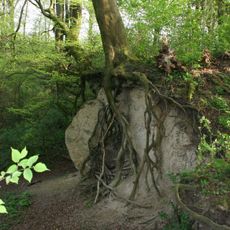
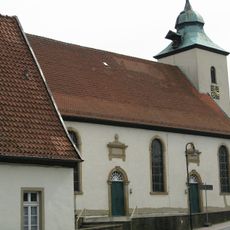
Wittekindsburg, Medieval fortification in Wallenhorst, Germany.
Wittekindsburg is a ruined early medieval hillfort on a spur of the Wiehengebirge above the Nettetal near Rulle. Its main castle measures 140 by 110 metres; the west side has an 85 cm dry-stone wall with a ditch up to 3.15 m deep, the east side a mortared wall up to 1.15 m thick with a ditch up to 3.90 m deep. A round tower sits in the southwest corner, a square tower 6.75 m wide in the northeast corner.
The ramparts outside the main castle are seen as a Saxon refuge fort from before Charlemagne's Saxon Wars (772-804). The main castle was in use from the late 8th to the late 10th century, and its use ended around 1000. Carl Schuchhardt carried out the first investigations around 1890; larger excavations ran from 1966 to 1972 and were continued in 2001. The first written mention dates from a 1253 charter of Rulle Abbey.
The name Wittekindsburg is a popular label: many fortifications in the Osnabrück region and northern Westphalia were called after the Saxon leader Widukind, and the sources state that no actual link to him can be derived. The site is first mentioned in a 1253 charter of Rulle Abbey, which refers to a farmhouse "in the Wittekindsburg".
The grounds are freely accessible, allowing visitors to explore the remains at their own pace, with preserved sections of two defensive towers and multiple earthen barriers visible. The elevated location on a ridge offers views across the surrounding landscape and makes the site navigable in most weather conditions.
The site ranks among the largest early medieval fortification complexes in Lower Saxony and represents one of the region's most important archaeological finds from that era. Despite its size and historical importance, it remains less well-known than many other medieval sites across Germany.
The community of curious travelers
AroundUs brings together thousands of curated places, local tips, and hidden gems, enriched daily by 93,997 contributors worldwide.