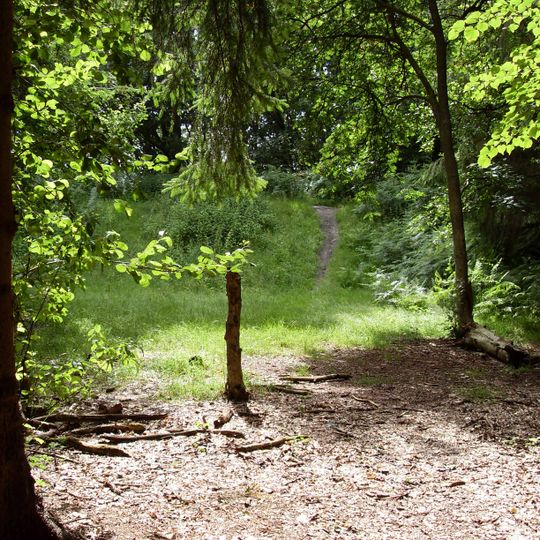
Wittorfer Burg, Medieval lowland castle in Neumünster, Germany.
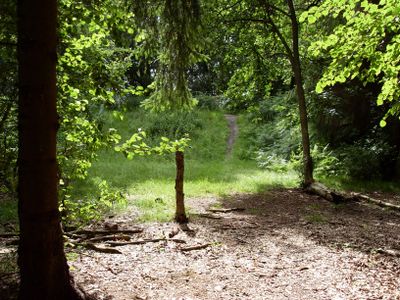
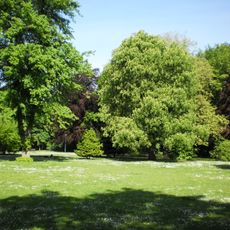
Wittorfer Burg is a lowland rampart castle near Wittorf in the southwest of Neumünster, where the Schwale flows into the Stör. It lies on a roughly 500-metre-long sandy island protected by the two rivers and a marshy lowland to the east. Of the ring wall and ditches, up to four-metre-high remains survive, but dense, unkempt growth makes them hard to make out at first glance.
Wittorfer Burg probably originated in the 9th century as part of the Limes Saxoniae, defending the Saxon area against the Wends from the east and the Danes from the north. Pottery finds show it was in use from the 9th century until at least the second half of the 11th century. Ash layers from excavations indicate the castle burned down and was destroyed twice in fighting.
The name Wittorfer Burg comes from the village of Wittorf, where the earthwork lies at the mouth of the Schwale. Excavations in 1949 uncovered traces of several Saxon settlements around the rampart, and pottery finds show the site was in use from the 9th century into the second half of the 11th.
The site is freely accessible and the earthen fortifications can be easily explored on foot, though you should expect vegetation coverage. Visiting in colder months works best when plant growth is less dense and the structures become more visible.
The fortress used a building method combining timber and rammed earth, reinforced by wooden stakes driven into the ground. This shows how skillfully people worked with materials available in the local landscape.
The community of curious travelers
AroundUs brings together thousands of curated places, local tips, and hidden gems, enriched daily by 94,554 contributors worldwide.