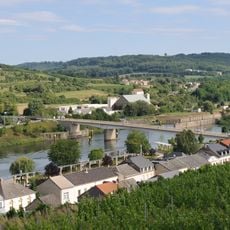
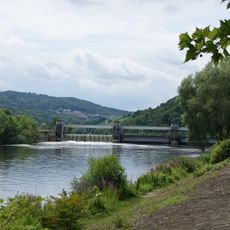
Schengen bridge, Road bridge between Schengen, Luxembourg and Perl, Germany.
The Schengen bridge is a prestressed concrete box-girder road bridge over the Moselle, 147.5 metres long with spans of 39.0, 69.5 and 39.0 metres. It carries the Luxembourg N10 and the German B407 between Schengen and Perl, with one lane in each direction and footpaths on both sides. It stands at Moselle-km 241.96, 6.63 metres above the high-water mark.
A steel three-span arch bridge built by Paul Würth & Cie in 1908–1909 replaced a ferry at this crossing; its spans measured 40, 70 and 40 m over a total of 150 m. It was blown up on 15 September 1939 at the start of the Second World War. The present prestressed concrete hollow-box bridge, 147.5 m long with the same span sequence, opened in 1959.
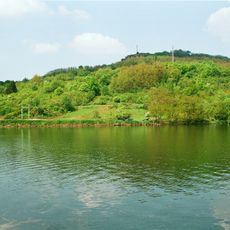
The bridge links two wine-producing areas, with German vineyards on one bank and Luxembourg wine estates on the other side of the Moselle River. Visitors can observe how this landscape has been shaped by cultivation over generations.
The road across the bridge has one lane in each direction, and footpaths run along both sides. The Schengen Viaduct of the Autoroute 13 and the Bundesautobahn 8 crosses the Moselle about 860 metres downstream, at Moselle-km 241.10. The three-country point where France, Luxembourg and Germany meet lies close to the bridge.
The bridge stands at Moselle-km 241.96, 6.63 m above the headwater level; the Schengen Viaduct for the A13 and A8 crosses downstream at km 241.10. The three-border point of France, Luxembourg and Germany lies close by. The 1908–1909 steel bridge was built by Paul Würth & Cie, and a ferry ran here before it opened.
The community of curious travelers
AroundUs brings together thousands of curated places, local tips, and hidden gems, enriched daily by 93,363 contributors worldwide.