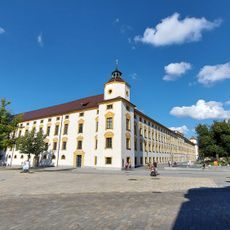
Fürstäbtliche Residenz, Baroque monastic residence complex in Kempten, Germany.
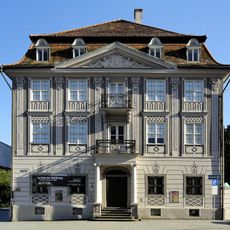
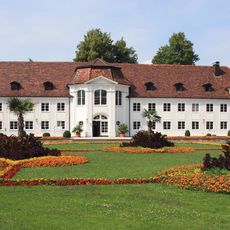
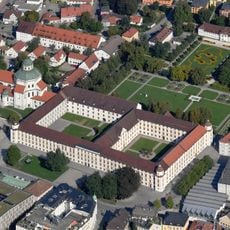
The Fürstäbtliche Residenz is a double-courtyard baroque complex begun in 1651 under Prince-Abbot Roman Giel von Gielsberg, partly on the foundations of the demolished Romanesque basilica. Michael Beer of Vorarlberg started the work; Johann Serro continued it, adding the central cross wing in 1656 and the wings around the eastern courtyard in 1660/61. The south and west wings followed in 1661–1664, and the northwest corner tower was finished in 1668. The ceremonial rooms on the southwest side, completed by 1743, hold paintings by Franz Georg Hermann, sculptures by Egid Verhelst and stucco by Johann Georg Üblher and other Wessobrunn artists.
Construction began in 1651 under Prince-Abbot Roman Giel von Gielsberg on the ruins of a destroyed Benedictine monastery founded around 750, with the building completed by 1670 and its sumptuous interior decoration finished between 1732 and 1742.
The residence was both a princely seat and a monastery: the eastern wing originally held the princely rooms, while the western part facing St. Lorenz served the monastic community. Around 1732, under Prince-Abbot Anselm von Reichlin-Meldegg, rooms on the southwest side were turned into ceremonial state rooms, and the monks moved into the east wing. The decoration combines paintings by Franz Georg Hermann, sculptures by Munich court sculptor Egid Verhelst and stucco by Johann Georg Üblher and other Wessobrunn artists.
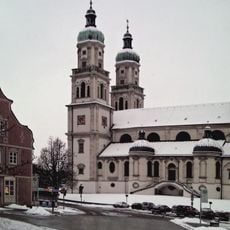
The residence now houses the Kempten district and local courts, so the historic halls are not freely walkable; tours of the ceremonial rooms are arranged by the Heimatverein Kempten, while the Bavarian Palace Administration is the owner. The building sits between Residenzplatz to the south and the Hofgarten to the north, with St. Lorenz church on the hill to the west.
The residence was built partly over the foundations of the Romanesque basilica destroyed by Swedish troops on 22 May 1632; the earlier monastery on the site was founded in the mid-8th century by Abbot Audogar, possibly a relative of the Carolingian queen Hildegard. Since 1803 the complex has served Bavarian state purposes, and today it houses Kempten's district and regional courts.
The community of curious travelers
AroundUs brings together thousands of curated places, local tips, and hidden gems, enriched daily by 92,630 contributors worldwide.