Abteigarten, Cultural heritage park in Quedlinburg, Germany
The Abteigarten is a park in the center of Quedlinburg that links several garden areas with pathways, seating spots, and open green spaces. The grounds offer places to rest and invite walking through its various sections.
The site served as the garden of the abbess of Quedlinburg's convent in the Middle Ages. It was probably laid out as a garden in 1720 and designed in Baroque style by 1769, with a large central basin and eight parterres. After the convent was dissolved in 1803, it was leased and then sold in 1827 to the former convent gardener Samuel Lorenz Ziemann, who turned it into a kitchen garden. From the late 19th century the Dippe family used it for seed breeding, and after 1945 the GDR's plant-breeding institute grew flowers and vegetables there until 1991.
The garden's name recalls its use as the abbess's garden of the Quedlinburg convent. From 1750 to 1753 Heinrich Mette, later co-founder of Quedlinburg seed cultivation, trained here as a gardener under Johann Heinrich Ziemann. Today rectangular beds of wild and summer flowers recall the site's later use for seed breeding.
The garden lies south of the Schlossberg and north of the Brühlpark, with the Holländer-Graben along its southern edge. A visitor car park was laid out on the north side and the Abteigasse repaved; the north fence was rebuilt after a historic model with a two-winged gate. Paths follow the old Baroque layout, and the axis toward the Brühl was reopened after 2005.
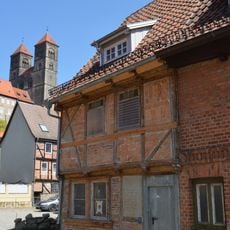
From here you can see the Collegiate Church directly, where greenery and medieval architecture meet in a single view. This proximity makes the park a place where history becomes part of everyday experience.
The community of curious travelers
AroundUs brings together thousands of curated places, local tips, and hidden gems, enriched daily by 92,715 contributors worldwide.