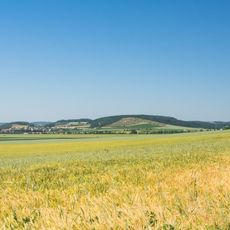
Hexenküche im Kaufertsberg, Natural monument cave in Möttingen, Germany
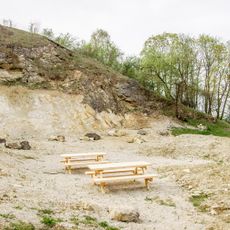
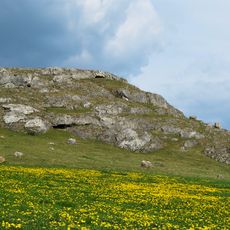
Hexenküche im Kaufertsberg is a shallow horizontal cave near Möttingen where visitors enter through a narrow opening. The roof slopes gently toward the valley floor, creating a naturally sheltered space inside.
The cave yielded few Palaeolithic finds, only stone tools and animal bones from the end of the Ice Age. Its key discovery is a head burial: a man's skull with the lower jaw and the first two cervical vertebrae, found in the cave. The site is recorded as Bavarian archaeological monument D-7-7129-0200.
The cave is registered as geotope 779R007 by the Bavarian State Office for the Environment and as archaeological monument D-7-7129-0200; the Fränkische Alb cave register lists it as M 14. Its name, "Witches' Kitchen", is not explained in the sources, which record only the open-top cave ruin behind the rock roof.
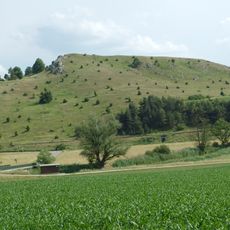
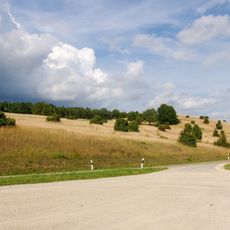
The cave lies about 200 metres east of Lierheim on the south-facing slope of the Kaufertsberg, above the valley floor of the Eger. A slightly overhanging rock roof forms the entrance, and a passage leads from there into the mountain to the open-topped cave ruin. The site is a protected natural monument and geotope, so visitors should stay on the path and leave rocks and finds in place.
The cave's name, "Hexenküche" (witches' kitchen), is not explained in the sources; what is documented is a head burial: a man's skull was found with its lower jaw and the first two cervical vertebrae still attached, alongside stone tools and animal bones from the end of the Ice Age.
The community of curious travelers
AroundUs brings together thousands of curated places, local tips, and hidden gems, enriched daily by 94,326 contributors worldwide.