Heilige Hallen, Nature reserve in Sebnitz, Germany.
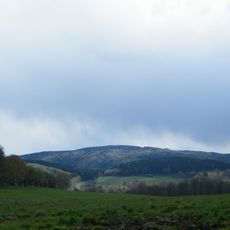
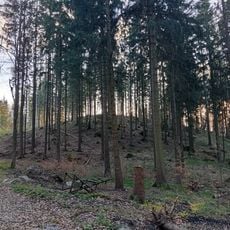
Heilige Hallen is a 32.78-hectare nature reserve on the steep north-west slope of the 599-metre Tanečnice, east of Sebnitz, reaching almost to the Sebnitz river. It protects acidophilous beech forest of habitat type 9110, with a hall-like character and almost no shrub layer. The bedrock is biotite granodiorite of the Zawidów type, with block fields on the steeper slopes.
The area was provisionally protected in 1958 and designated a nature reserve on 30 March 1961, covering 32.78 hectares. During the Thirty Years' War the Sebnitz Forest served repeatedly as a refuge for the inhabitants of Sebnitz and neighbouring villages; legend holds that newborns were baptised in the Taufstein, a low granodiorite boulder with a hollow in the upper part of the reserve.
The name Heilige Hallen refers to the hall-like beech forest, not to rock chambers. In the Thirty Years' War the forest served repeatedly as a refuge for the people of Sebnitz and nearby villages. Legend says newborns were baptized in the Taufstein, a low granodiorite boulder with a hollow in the upper part of the reserve.
A green-marked circular hiking route crosses the reserve and the surrounding Sebnitz Forest, following old paths such as the Kälbersteig, Finsterwinkelweg, Langer Flügel and Alte Nixdorfer Straße. The reserve spans roughly 340 to 510 metres in altitude on the steep northwest slope of the Tanečnice, with the Wolfsbach flowing through its lower part.
In the upper part of the reserve lies the Taufstein, a low granodiorite boulder with a hollow. Legend says newborns were baptised in it when Sebnitz residents sheltered in these woods during the Thirty Years' War. A green-marked circular trail through the Sebnitz Forest follows old paths such as the Kälbersteig and Finsterwinkelweg.
The community of curious travelers
AroundUs brings together thousands of curated places, local tips, and hidden gems, enriched daily by 94,417 contributors worldwide.