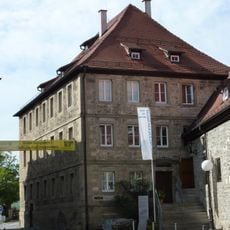
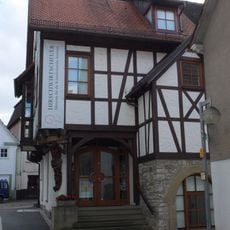
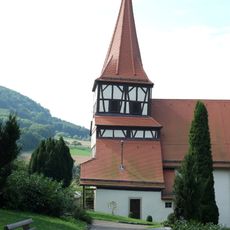
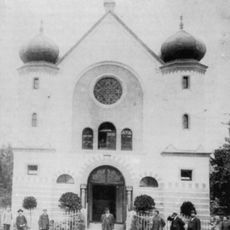
Schloss Künzelsau, Renaissance château in Künzelsau, Germany.
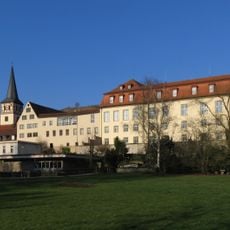
Schloss Künzelsau is a four-winged complex featuring Mannerist architectural details and built on the site of an earlier fortified water castle. The layout includes open courtyards and ornamented facades characteristic of that building era.
The von Stein family is documented in Künzelsau from the 11th century; their heirs, the lords of Künzelsau, built a castle around 1248, which passed to the lords of Bartenau in 1341 and by inheritance to the lords of Stetten in 1390. A 1493 Burgfrieden agreement placed the castle under joint administration by several rulers. Around 1600 the Hohenlohe acquired the whole complex, and Johann Ludwig von Hohenlohe had a three-storey Renaissance palace with four corner towers built from 1679 to 1681. In 1871 the House of Hohenlohe-Öhringen sold the partly neglected building to the state of Württemberg, which renovated it for school use.
The name Bartenau comes from the lords of Bartenau, who inherited the castle of the Künzelsau family in 1341 and gave it their name. In 1493 a Burgfriedensvertrag fixed the Ganerbenschaft, the joint administration of Künzelsau by several rulers, which also applied to the Bartenau. The site is now the Schlossgymnasium Künzelsau, a state Aufbaugymnasium with boarding school.
The building now houses a state gymnasium with boarding facilities that underwent major renovation work. Keep in mind that it functions as an active school campus, so visitor access may be limited during school hours.
The four corner towers of the 1679–1681 Renaissance building survived into the school era; the Hohenlohe-Öhringen line sold the partly neglected castle to the state of Württemberg in 1871, and the state then renovated and extended it for school use. The school still occupies the building today as Schlossgymnasium Künzelsau, a state Aufbaugymnasium with boarding house.
The community of curious travelers
AroundUs brings together thousands of curated places, local tips, and hidden gems, enriched daily by 92,843 contributors worldwide.