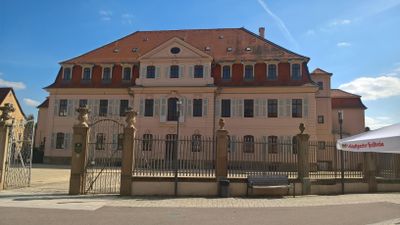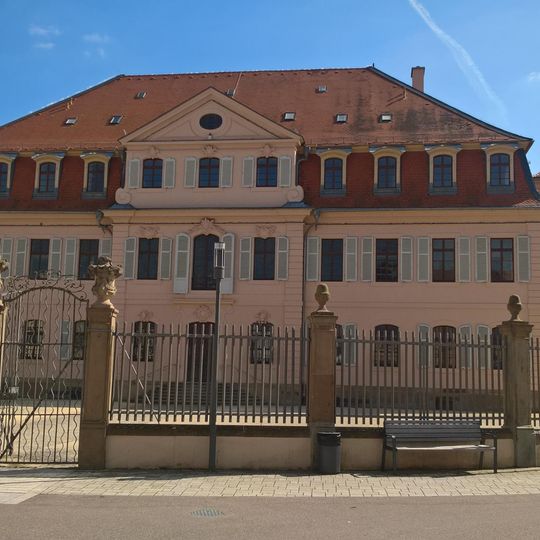
Stadionsches Schloss, Late Baroque palace in Bönnigheim, Germany.
Stadionsches Schloss is a two-story building with a mansard roof and central projection, showing French Baroque style with Rococo decorations. The facade is balanced and features carefully designed windows and ornamental details that reflect the wealth and status of its original owner.
Anton Heinrich Friedrich von Stadion inherited the Liebenstein estates in Bönnigheim in 1742 and ended the joint inheritance by purchasing the town. In 1753 he had the 1560 Liebenstein castle demolished, except for the Kavaliersbau, and commissioned a new palace planned by Anselm Franz von Ritter zu Groenesteyn; construction, coordinated by Anton Haaf, was completed in 1756.
The palace takes its name from the von Stadion family, who had it built from 1753 and used it as a country seat. The stucco work inside was made by pupils of the Mainz court stuccoist Johann Peter Jäger, and probably by Jäger himself in the festival hall. Four linked medallions there are meant to show the four seasons.
The palace stands at the end of Hauptstraße in the Liebensteiner Viertel, with a forecourt behind an iron fence. The former washhouse now holds the Museum Sophie La Roche, and the former forest prison houses a wine shop. The building itself is not open to visitors; the town is discussing a sale.
The banquet hall was originally decorated with precious leather wallpaper that remained in place until 1931. This unusual material was later removed and is now on display at Ludwigsburg Residential Palace.
The community of curious travelers
AroundUs brings together thousands of curated places, local tips, and hidden gems, enriched daily by 92,885 contributors worldwide.