Schloss Rodenberg, Water castle and open-air museum in Rodenberg, Germany
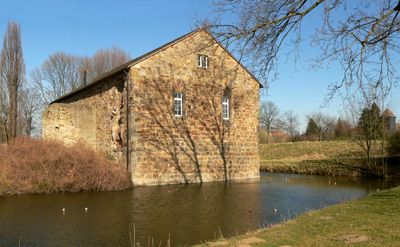
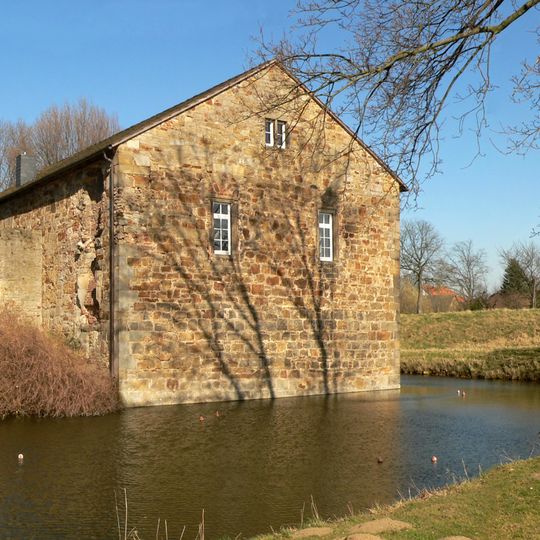
Schloss Rodenberg is a former water castle in the centre of Rodenberg, now an open-air museum. Its only standing building is the Ständehaus, the former Palas, on an island in the water-filled moat; a stair turret and the remains of a chimney are visible on its exterior. Around it the rampart survives, about 24 m wide at its base and 4 m high, with an inner moat up to 30 m wide.
Count Adolf IV of Schaumburg probably founded the water castle between 1228 and 1240 at a ford of the Rodenberger Aue. It was first documented in 1317 as "in castro Rodenberghe"; Adolf VII strengthened it between 1330 and 1348 and moved his residence there. In 1553 Brunswick troops besieged it with cannons, and in 1560 Jakob Kölling and Heinrich Schrader rebuilt the Palas in Weser Renaissance style. After Otto V died in 1647, the castle passed to Hesse-Kassel.
The Ständehaus, the last original building still standing, now displays collections about the region's past. Visitors can see objects and documents that show how people lived and worked in this area over the centuries.
The grounds lie in the flat centre of Rodenberg, ringed by the Rodenberger Aue and the Mühlgraben; the Ständehaus sits on an island in the water-filled moat. The open-air museum created in 2005 presents the excavated fortifications, including the wall, bastions and rondels. The rampart is about 24 m wide at its base and 4 m high, with an inner moat up to 30 m across.
The castle grounds became an open-air museum in 2005 after four years of excavations. Two bastions and rondels survive in the earth, while three others vanished through stone theft. A filled outer ditch, the Butengraben, up to 20 m wide, can still be traced on three sides.
The community of curious travelers
AroundUs brings together thousands of curated places, local tips, and hidden gems, enriched daily by 92,850 contributors worldwide.