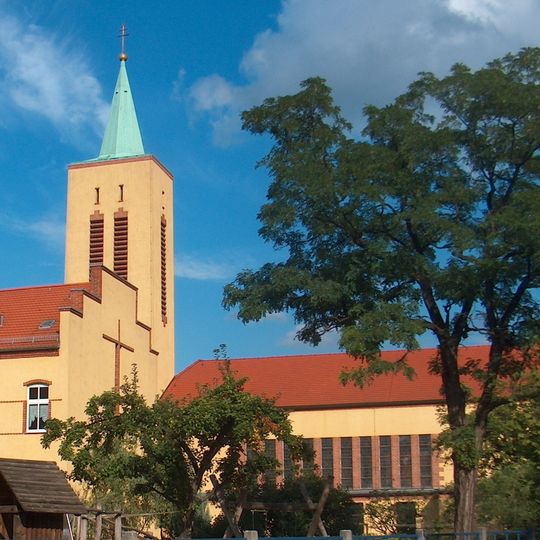
St. Antonius, Catholic church building in Babelsberg, Germany.
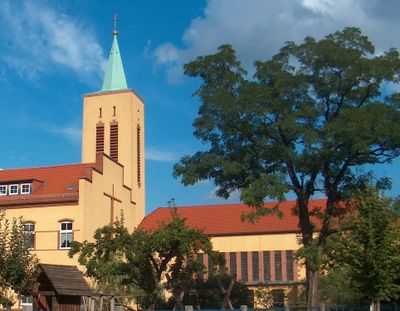
St. Antonius is a rectangular hall church with a full-width apse, built in 1934 to designs by Wilhelm Fahlbusch. Its red clinker-brick walls are pierced by ten tall, narrow windows on each side, and a 34-metre tower with a copper spire and papal cross stands at the north-west corner. A side aisle with its own altar runs along the west wall, with a baptistery to the north and a sacristy to the south.
Catholics in Nowawes and Neuendorf had only the Peter-and-Paul church in central Potsdam; the parish bought this site in 1891, and a parish house with chapel followed in 1905, blessed on 7 October 1906. The foundation stone of the present church was laid on 30 July 1933, and Berlin bishop Nikolaus Bares consecrated it on 15 April 1934. Architect Wilhelm Fahlbusch had already built St. Michael in Wannsee for the parish.
The apse mosaic, installed in 1942, shows the Lamb of God on the book with seven seals, adored by 24 elders and flanked by angels; Egbert Lammers designed it, and the Berlin firm August Wagner executed it. Lammers gave some elders Asian and African features, a quiet protest against Nazi racial ideology.
The interior is accessible during services and offers a quiet environment for visitors who want to explore the space. The asymmetrical tower on the facade serves as a clear landmark when approaching the building.
The apse mosaic, made in 1942 by the Berlin firm August Wagner after designs by Egbert Lammers, shows the Adoration of the Lamb from Revelation. Lammers gave some of the 24 elders Asian and African facial features, a subtle protest against Nazi racial ideology. The workshops were then mostly busy with state propaganda commissions.
The community of curious travelers
AroundUs brings together thousands of curated places, local tips, and hidden gems, enriched daily by 92,733 contributors worldwide.