AOK-Gebäude, Architectural heritage monument in Berlin-Mitte, Germany.
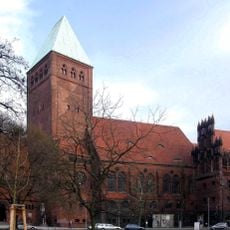
The AOK-Gebäude is a six-story structure with steel skeleton construction and dark purple brick facades, decorated with terracotta figures on six flanking staircase pillars. The complex extends with an elongated wing along the street and two rear wings that enclose a large covered courtyard.
Albert Gottheiner designed the building for the AOK Berlin central administration; construction began in 1930 and it opened in 1933. From 1955 to 1990 it housed the SED's Parteihochschule "Karl Marx", a state-registered university with the right to award doctorates and habilitations, training officials and young socialists from developing countries. A 1971 extension on Am Köllnischen Park served congresses and Jugendweihe ceremonies.
Berliners nicknamed the red-brick building the "Rotes Kloster" (Red Monastery), a reference to its colour and its use as the SED cadre school from 1955 to 1990. The six terracotta figures on the pillar templates were carved by sculptor Anton Lechtner.
The main entrance front with its eight-axis central section, portal and open staircase faces Rungestraße; the six terracotta figures by sculptor Anton Lechtner sit on the pillar templates up to the fifth floor. The two-storey western part borders Wassergasse. Since 2013 neighbouring annexes, including the 1971 cultural extension, have been demolished, so the street view is partly a construction site.
The sculptor Anton Lechtner made the six terracotta figures on the pillar templates and the plastic surface design of the brick cladding. Because of its red colour and its use as an SED cadre school, Berliners nicknamed the building the "Rotes Kloster" (Red Monastery).
The community of curious travelers
AroundUs brings together thousands of curated places, local tips, and hidden gems, enriched daily by 92,654 contributors worldwide.