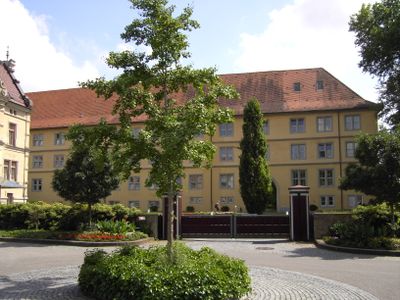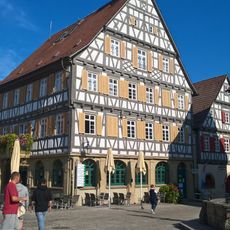
Schloss Winnental, Renaissance château in Winnenden, Germany.
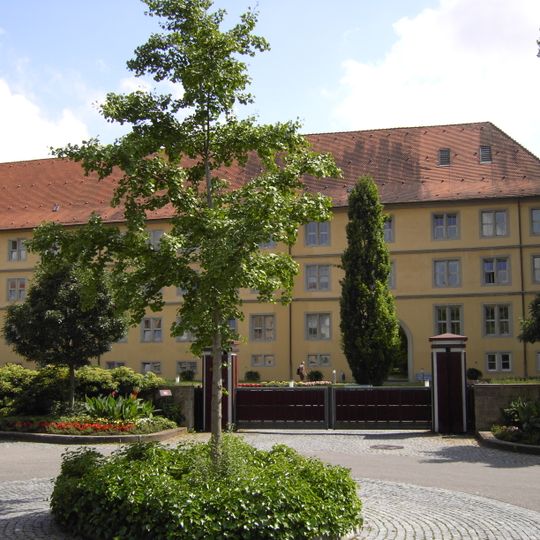
Schloss Winnental is a three-wing complex in Winnenden whose oldest part, the Komturbau, dates from around 1300. East of it, architect Matthias Weiss built a three-story Corps de Logis between 1684 and 1688, later joined by the Kavalierbau wing. The east wing was demolished in 1975 and replaced by a new building.
Berthold von Neuffen donated his Winnenden estate to the Teutonic Order in 1288, which founded a commandery there; the Komturbau, the oldest surviving building, dates from around 1300. Duke Eberhard III of Württemberg bought the commandery in 1665 for 48,000 gulden, and architect Matthias Weiß built the three-story Corps de Logis between 1684 and 1688. From 1677 the castle served as an apanage residence of the Württemberg-Winnental line, and from 1830 to 1833 Friedrich Bernhard Adam Groß converted it into a nerve sanatorium, whose successor clinic still occupies it.
The name Winnental comes from the Württemberg-Winnental branch, founded by administrator Friedrich Carl, which used the castle as an apanage residence from 1677 until the line died out in 1733. In 1796 court architect Reinhard Ferdinand Heinrich Fischer refitted the interior as a widow's seat for Duchess Sophie Albertine von Beichlingen, who lived there until 1807.
The castle today functions as an active medical clinic, so the public can only visit the exterior areas and certain communal spaces. It is helpful to check in advance as accessibility may be limited depending on ongoing medical activities.
The oldest part is the Komturbau, the western wing, built around 1300 and made the Komtur's seat in 1423. The three-storey Corps de Logis was added east of it by architect Matthias Weiß between 1684 and 1688, and the Kavalierbau wing completed the three-wing layout shortly after.
The community of curious travelers
AroundUs brings together thousands of curated places, local tips, and hidden gems, enriched daily by 93,866 contributors worldwide.