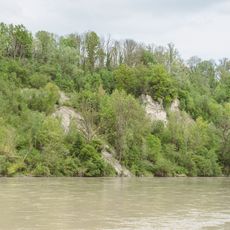
Schloss Kling, Archaeological heritage site in Babensham, Germany.
Schloss Kling is a vanished hilltop castle above the hamlet of Kling in Babensham, Rosenheim district. Michael Wening's 1721 engraving shows a four-winged Renaissance palace with small corner watchtowers, a larger tower in the courtyard and a chapel in the southern princely wing, fronted by two outbuildings and a moat crossed by a bridge. Only low remains survive; the south retaining wall was uncovered in 1976–1980.
The castle was founded around 1070 by Walter von Kling, who served as bailiff of Ebersberg Monastery and controlled an allodial county. During the War of Spanish Succession from 1704 to 1705, imperial forces destroyed the fortifications, beginning the ruin's decline.
The name Kling appears in medieval records as Chlingenperch, and the castle was the seat of a ducal land judge from 1266, when a judge named Walther held office there. Later, the prince-bishop's steward Zacharias von Hogenrain, who built the Holy Spirit Hospital in Wasserburg, served as the most notable Pfleger. The site is now marked by an information panel at the southern wall.
The ruins are freely accessible, with information panels placed at the southern wall of the former structure. Visitors should expect uneven ground and outdoor conditions typical of an active archaeological site.
The 1721 engraving by Michael Wening shows a four-wing Renaissance palace with corner watchtowers, an inner courtyard tower and a chapel in the southern prince's wing. A bridge over a moat led into a walled forecourt flanked by two long buildings. The engraving is reproduced on a panel at the south wall, beneath Wening's praise of the site as one of the most beautiful landscapes.
The community of curious travelers
AroundUs brings together thousands of curated places, local tips, and hidden gems, enriched daily by 94,646 contributors worldwide.