Magnustritt, Architectural heritage monument in Füssen, Germany
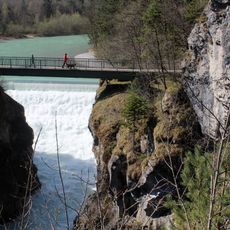
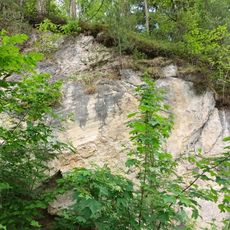
Magnustritt is a shoe-shaped hollow in the Lusalten, a rock jutting over the Füssener Lechschlucht about 100 metres north of the Lechfall. Beside it stands a wrought-iron cross with a crucifixion group painted on faded sheet metal, dated 1726 or 1730. A short chain-secured path leads up from the Tiroler Straße.
The Lusalten rock was already a sacred site in pre-Christian times; monks of St. Mang derived its name from Julii saltus, linking it to a legend of Julius Caesar leaping the Lech, later transferred to Saint Magnus. A 980 version of the legend has Magnus driving out demons there, without any jump. Around 1600 Abbot Martin Stempfle added the leap over the gorge, and in 1626 a cross was set up on the rock. Pilgrimages continued until 1920.
The name Lusalten was derived by monks of St. Mang from Julii saltus, linking an older legend of Julius Caesar leaping the Lech to Saint Magnus. Rainwater collecting in the footprint was credited by the people with healing powers, and pilgrimages to the Magnustritt continued until 1920.
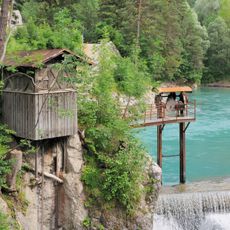
The Magnustritt lies on the Lusalten rock on the high bank of the Lech gorge, just under 100 metres north of the Lechfall. From the Tiroler Straße a short path secured with a chain leads up to the rock. The rock is visible from the Maxsteg bridge, which crosses the Lech at the waterfall.
The name Lusalten, for the rock bearing the Magnustritt, was traced by monks of St. Mang to Julii saltus, hinting at an older legend that Julius Caesar leapt the Lech, later transferred to Saint Magnus. The name itself actually predates that reading.
The community of curious travelers
AroundUs brings together thousands of curated places, local tips, and hidden gems, enriched daily by 93,760 contributors worldwide.