St. Hubertus, Catholic parish church in Schmidt, Nideggen, Germany
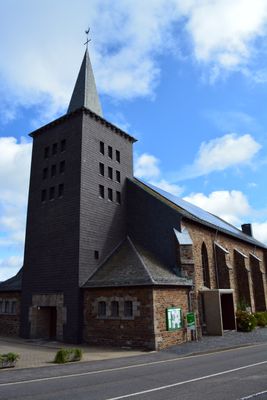
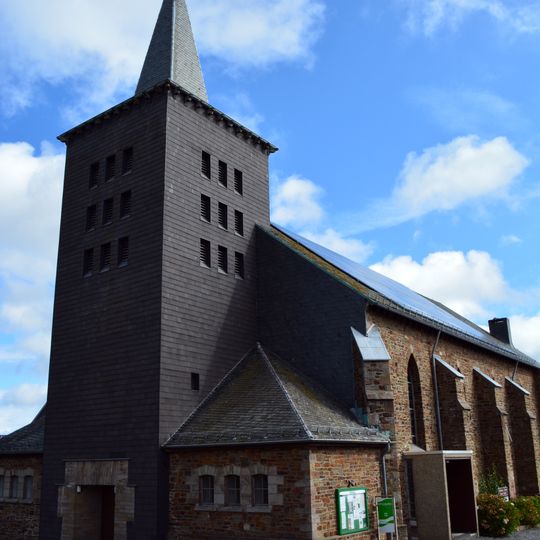
St. Hubertus is a neo-Gothic hall church in Schmidt, Nideggen, built from 1866 to plans probably by Cologne architect Franz Schmitz. Its rough light-brown stone body has a steep dark roof with solar panels, and a dark grey square tower with a pointed spire stands to the left. A lower stone annex with a hipped slate roof bears a green notice board reading "ST. HUBERTUS".
A first Baroque church was built in Schmidt in 1684–1685, consecrated on 8 September 1685; around 1760 the village became an independent parish. The dilapidated building was demolished from 19 March 1866 and replaced by a neo-Gothic hall church, probably designed by Cologne architect Franz Schmitz, whose foundation stone was laid on 5 June 1866. Destroyed to the outer walls in the 1944 All Souls' Day battle, it was rebuilt from 20 March 1949 and reconsecrated on 5 November 1950 by Auxiliary Bishop Friedrich Hünermann.
The church is dedicated to Saint Hubertus, the patron saint of hunters and forest workers, reflecting its importance to the local community. The name connects the building to long-standing traditions and shows which saint held special meaning for people here.
The building is accessible and can be visited during regular daylight hours. Visitors should keep in mind that as an active church, regular services take place that may affect access at certain times.
Locals call the church St. Mokka, after the coffee smuggling across the nearby Belgian border that flourished until 1953. Parishioners who had profited initially gave nothing for the rebuild, until sermons by pastor Josef Bayer prompted about 250,000 marks in the collection box, financing the reconstruction.
The community of curious travelers
AroundUs brings together thousands of curated places, local tips, and hidden gems, enriched daily by 93,896 contributors worldwide.