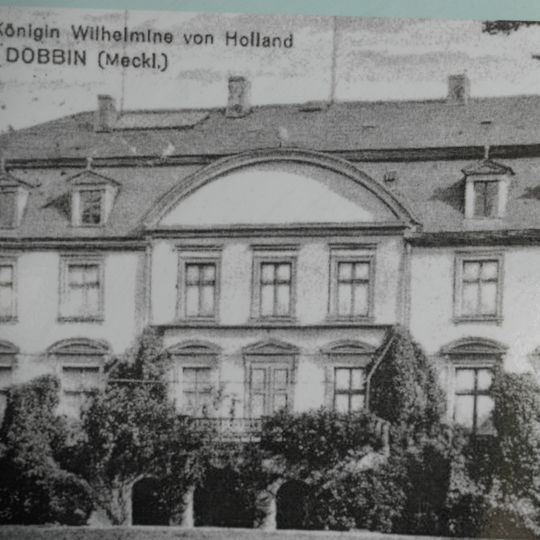
Schloss Dobbin, Manor house in Dobbin-Linstow, Germany
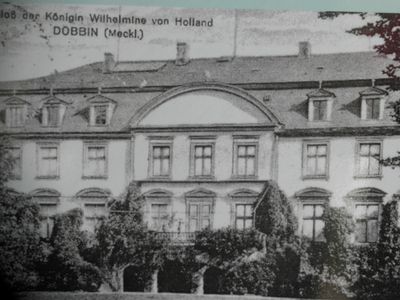
Schloss Dobbin is a two-storey manor house with a light-coloured facade, a dark sloping roof and a broad arched gable spanning the central three bays. Three dormer windows sit on the upper roofline, and a balcony with a railing runs across the central ground-floor openings. Dense climbing plants cover much of the ground floor. The estate belonged to the Barold family, whose line died out in 1746.
Dobbin was an old fief of the Wendish Barold family, documented from 1226 and extinct in 1746; a Rudolph Barold, senior, was recorded living at Dobbin in 1347. The estate passed by pledge to Moritz von Walsleben in 1627, and in 1647 the manor house of Johann von Walsleben burned down through arson by Curd von Restorff zu Lindenbeck. From 1853 the von Brocken family held Dobbin for three generations and gave the village and estate a new character still legible in its buildings.
The name Dobbin goes back to a Slavic settlement east of a lowland castle on a peninsula in the Krakower Obersee, named after a prince: "Ort des Doba". The estate was an old fief of the Wendish Barold family, documented from 1226 and extinct in 1746. Legends about the old castle are linked with the name Niklot.
Schloss Dobbin lies in Dobbin-Linstow, east of the Krakower See, in the Rostock district. The estate once covered 2,500 hectares, of which 400 were woodland. The sources do not record opening times or public access, so confirm locally before travelling.
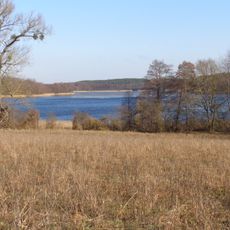
The estate once covered about 2,500 hectares, of which 400 hectares were woodland, and included the Hof Zietlitz. In the 19th century the von Brocken family laid out gardens, a park and avenues to create a gradual transition from farmland to pastures, lakes and forests.
The community of curious travelers
AroundUs brings together thousands of curated places, local tips, and hidden gems, enriched daily by 92,632 contributors worldwide.